

A cosmetic bottle neck finish code identifies a nominal neck diameter and a thread-finish series. It helps buyers narrow the options for a cap, pump, or sprayer, but it does not approve the final package. The bottle drawing, closure drawing, sealing surface, thread engagement, dip-tube specification, and assembled samples still have to agree. For sourcing teams, the practical rule is simple: use the code to shortlist components, then verify the real bottle-and-closure system before production.
How a bottle neck finish code works
Codes such as 24/410 and 28/410 contain two different pieces of information. Reading both matters because a closure with the correct nominal diameter can still have a different thread style or height. A bottle and closure normally need the same complete finish designation, supported by compatible drawings and physical samples.
The first number identifies nominal neck diameter
The first number is commonly used as the nominal diameter in millimeters across the outside of the neck threads. It is a size family, not a substitute for every controlled dimension. Finish drawings may also show the outside thread diameter, opening diameter, finish height, land, thread start, and other dimensions that affect filling clearance and closure engagement.
The 410 series describes the finish style
The second number identifies a thread-finish series. A 24/410 neck and a 24/400 neck share the same nominal diameter family, yet the closure profiles are different. A buyer should therefore avoid ordering a 24 mm closure without the series number. The same principle applies to 18/410, 20/410, 28/410, and 32/410 components.
Why the same printed code is only a starting point
Nominal codes reduce obvious mismatches, but they do not confirm material shrinkage, manufacturing tolerances, seal geometry, pump-gasket compression, thread quality, or decoration buildup near the neck. Suppliers may also use different drawings for products described with similar commercial language. Approval should rely on the current bottle and closure specifications for the exact model, followed by assembled testing.
Common cosmetic neck size families
The table below is a sourcing guide rather than a universal compatibility chart. Actual use varies by bottle design, formula, closure supplier, and market requirements.
| Finish | Typical package direction | Closure questions to resolve |
| 18/410 | Small treatment, sample, or concentrated-product packs | Is the opening adequate for filling, and is the selected dropper, cap, or sprayer built to the same finish? |
| 20/410 | Small skincare, toner, or targeted-dispensing bottles | Does the actuator, gasket, and dip-tube assembly match the bottle drawing and formula? |
| 24/410 | Mid-size personal-care packs using pumps, sprayers, or dispensing caps | Is the required output available, and does the closure seal on the specified land? |
| 28/410 | Larger lotion, shampoo, body-care, and refill packs | Will the pump fit the neck, deliver the target dose, and remain protected in distribution? |
| 32/410 | Higher-capacity bottles that need a wider pump or closure platform | Are the bottle finish, pump collar, thread engagement, and case-pack dimensions approved together? |
Match the neck finish to the dispensing system
Check the pump or sprayer as a complete assembly
For a lotion pump or fine-mist sprayer, confirm more than collar size. Review actuator style, gasket material, closure torque, output target, dip-tube outside diameter, tube cut, and any shipping lock. The spray bottle range can help buyers compare bottle formats, but the chosen sprayer still needs model-specific approval.
Review the land liner and thread engagement
The top sealing surface, often called the land, must work with the closure’s sealing method. Depending on the package, that may involve a gasket, liner, plug seal, or another contact surface. Too little thread engagement can weaken retention; excessive engagement may distort a liner or change closure orientation. Application and removal torque should be defined for the tested material and closure system.
Connect neck size with filling and dip tube needs
A wider neck can create more filling clearance, yet neck size should not be chosen in isolation. Formula viscosity, fill temperature, pump output, and the bottle shoulder determine what the production line and dispenser require. After selecting the pump, use the dip tube length guide to specify tube length and cut without treating the neck code as a tube measurement.
How to compare 24/410 and 28/410
The main difference is the nominal neck diameter, not a general quality level. A 24/410 format may suit a narrower bottle or a dispensing system available in that size. A 28/410 format provides a wider neck platform and is common on larger personal-care packs, but it can increase collar width and affect the package silhouette. Compare available pump outputs, filling clearance, bottle proportions, torque window, and distribution protection. The مجموعة زجاجات لوشن provides relevant bottle starting points, while the final choice should follow the selected model and formula.
Verification before a production order
- Request the current bottle-finish drawing and the matching closure or pump drawing.
- Confirm the complete code, material, color, decoration, gasket or liner, and dip-tube specification on the approval sample.
- Assemble production-representative components and check thread start, seating, closure orientation, and actuator clearance.
- Run formula compatibility, upright and inverted leakage checks, temperature conditioning, vibration or transit checks, and repeated-use testing appropriate to the product.
- Record the approved bottle, closure, pump, liner, and tube as one controlled component set. Requalify material or supplier changes.
A verified Jaunce pump bottle example
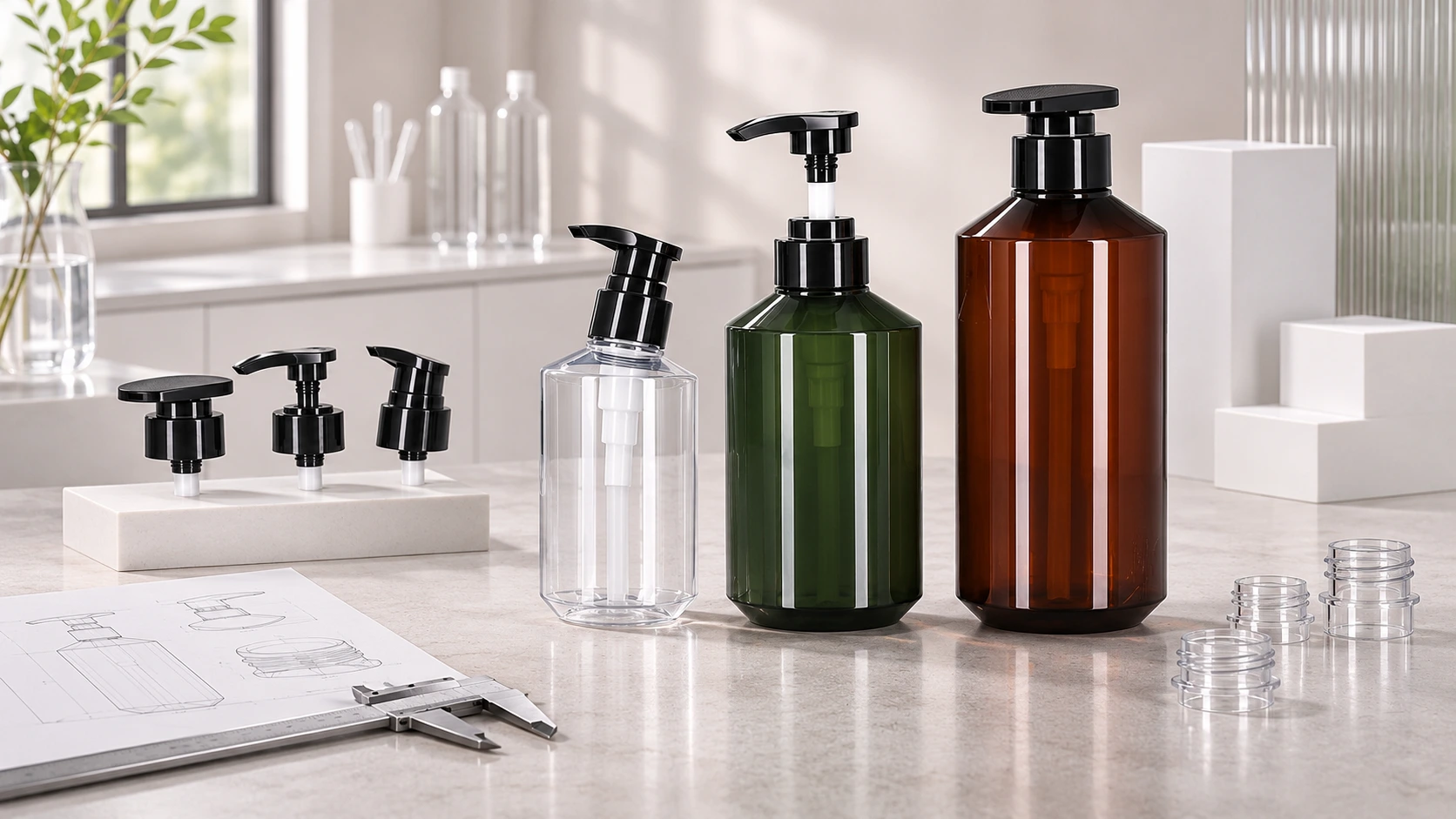
Jaunce lists a 300 ml and 500 ml PET lotion bottle model with a 28/410 pump for the 300 ml bottle and a 32/410 pump for the 500 ml bottle. The model supports silk-screen printing, hot stamping, labeling, and color spraying. These specifications belong to that product model; they should not be generalized to every bottle of the same capacity.

Information to include in an RFQ
Send the intended formula, fill volume, bottle material, neck finish, dispenser type, output target, dip-tube requirement, decoration, order quantity, and destination market. If the finish is not yet fixed, provide the preferred bottle shape and capacity and ask the supplier to propose a matched bottle-and-closure set. A drawing and assembled sample should resolve fit more reliably than a finish code copied from another package.
استنتاج
A neck finish code is an efficient filter, not a compatibility certificate. Read the nominal diameter and finish series together, compare current drawings, and approve the real bottle, closure, pump, liner, and dip tube as one system. This process prevents a familiar sourcing error: components that look compatible on a list but do not seal, orient, or dispense correctly after assembly.
For a model-specific recommendation, request a bottle and closure fit check with your capacity, formula, dispenser, decoration, and quantity requirements.
Frequently asked questions
What does 24/410 mean on a cosmetic bottle
It identifies a nominal 24 mm neck-diameter family and a 410 thread-finish series. The code narrows compatible components, but the exact bottle and closure drawings still need to match.
Will any 28/410 pump fit any 28/410 bottle
Not automatically. The code is necessary, but gasket design, thread tolerance, land geometry, dip tube, pump output, and manufacturing variation can affect assembly and performance.
Is 28/410 better than 24/410
Neither is inherently better. The appropriate size depends on bottle proportions, filling clearance, dispenser availability, output, formula, and distribution requirements.
When should neck finish compatibility be tested
Test before production approval and again when the bottle, closure, pump, liner, material, decoration, or supplier changes. Use production-representative components and the intended formula.