

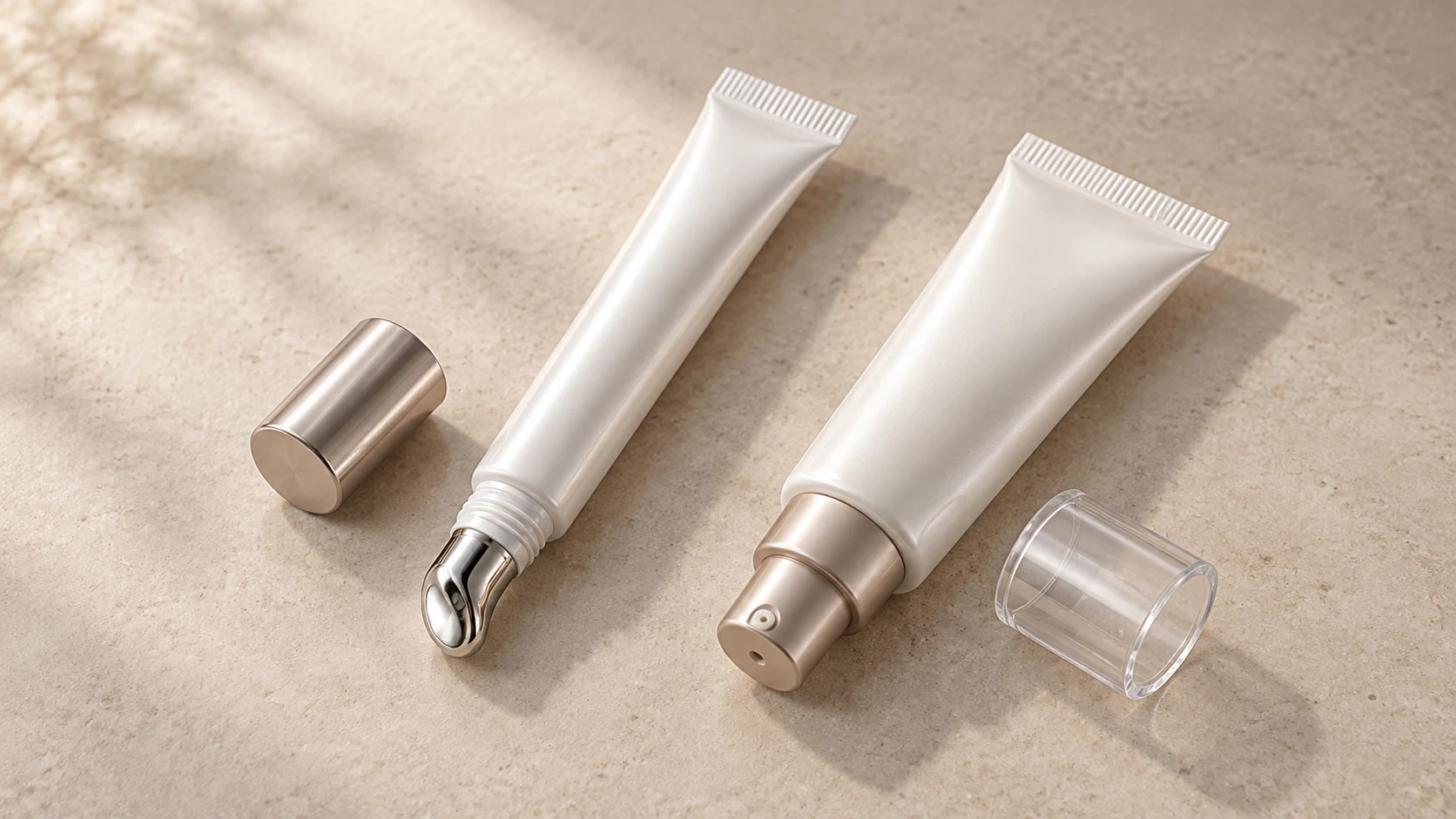
Eye cream packaging should be selected from the dose path, not from the look of the closure. An applicator tube lets the user squeeze product toward a shaped tip and may support direct placement around the eye. A pump tube adds a mechanical dispensing step and may offer a more repeatable actuation when the formula and pump are properly matched. Neither format is automatically more precise: precision depends on output, formula flow, user force, and the geometry of the outlet.
For a beauty brand evaluating eye cream tube packaging, the practical decision is whether control should come mainly from the user’s squeeze and applicator contact or from a metering mechanism. Define the target amount, where the product should land, and whether the package must apply, massage, or only dispense. Then compare filled samples under the intended routine.
Understand What Each Tube Format Controls
An applicator tube is usually a squeezable pack with a nozzle, angled tip, roller, or metal-contact head. Its advantage is a short path from package to skin. The user can place a small bead and spread it with the same component. Output, however, changes with squeeze force, tube stiffness, headspace, temperature, and how much product remains.
A pump tube combines a tube body with a pump system. The mechanism can separate the finger force from the product outlet and can be designed around a target output per actuation. It also adds parts, priming behavior, internal passages, and potential compatibility points. Some packs combine a pump with an applicator head, so an RFQ should describe the complete dispensing architecture rather than relying on the words applicator or pump alone.
| Decision factor | Applicator tube | Pump tube |
| Dose control | Driven by squeeze force, orifice, and tube recovery | Driven by pump output plus formula and priming behavior |
| Application | Can place and spread product directly | Usually dispenses first; may include a separate contact head |
| Formula path | Shorter path with fewer mechanical parts | More internal passages and wetted components |
| Approval focus | Squeeze feel, outlet cleanup, tip comfort | Prime, output repeatability, recovery, clogging |
Match Formula Behavior to the Dispensing Path
Evaluate more than viscosity
Viscosity is only a starting point. Eye creams can be shear-thinning, stringy, tacky, or slow to recover after pressure. A formula that passes through a nozzle during one bench test may tail at the outlet, pull back into the tip, or require excessive force after cool storage. Ask the formulator and filler for a realistic viscosity or flow range, then test the production-intent formula rather than a substitute gel.
For an applicator tube, adjust the orifice and tube wall response together. For a pump tube, confirm that the inlet, chamber, valve path, and actuator recover between uses. Do not assume that a pump with a published nominal output will deliver the same amount with every cream; the filled system has to demonstrate it.
Define the target dose and use pattern
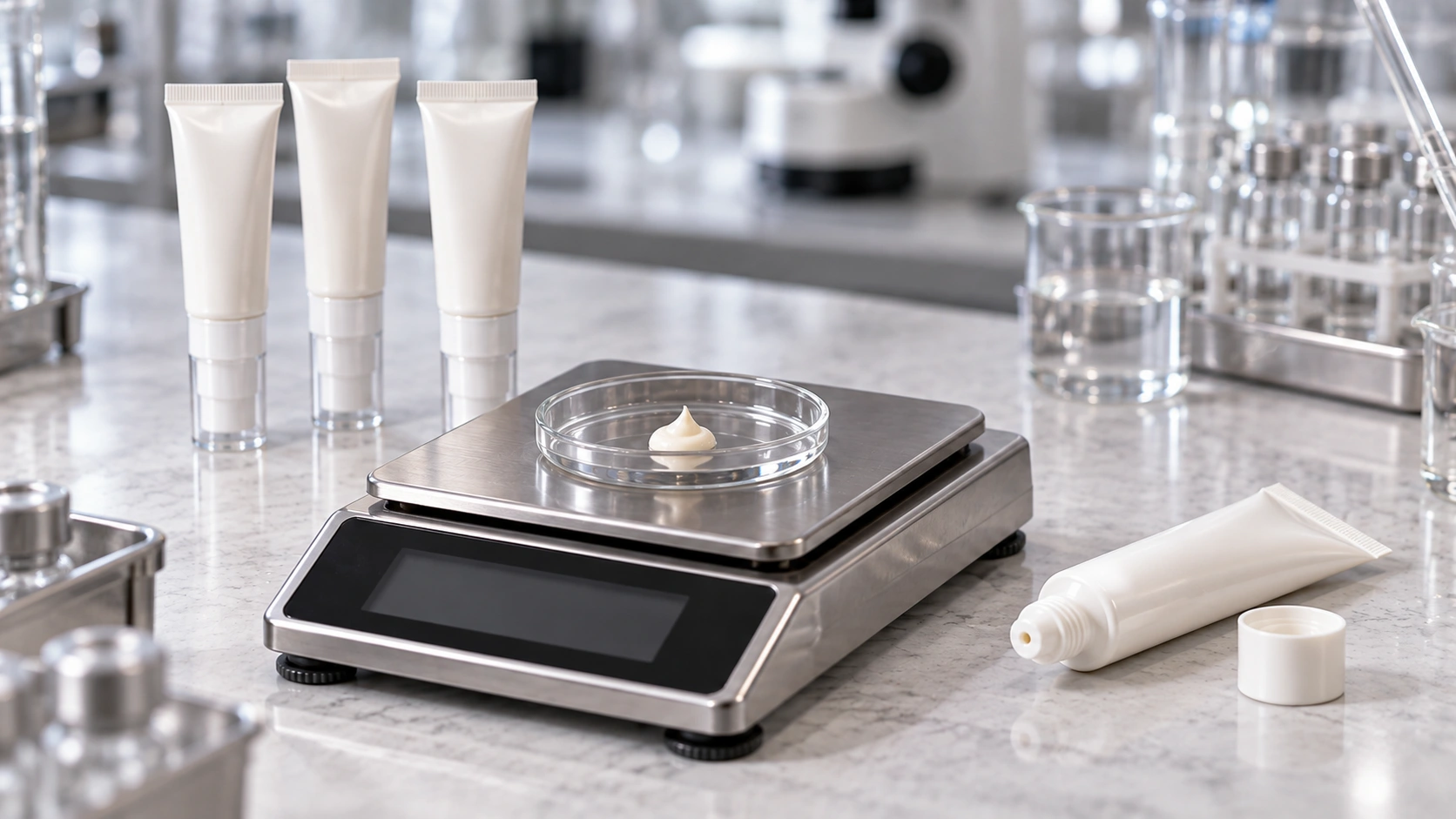
Write the routine in measurable terms. State whether one use means one pump, one short squeeze, or a bead of a specified length. Decide whether the amount is for one eye or both. A target such as controlled small-dose application is too vague for sampling. Weigh multiple dispenses from several units and compare the first use, normal use, and near-empty condition.
Also check how the package is held. A direct applicator may be used horizontally near the skin, while a pump may be actuated upright into a fingertip. If the consumer must change grip, remove a cap, and then massage with the pack, those actions belong in the usability trial.
Validate Precision With a Filled-Pack Trial
Use a short test sequence that follows the package from filling to repeated consumer use: fill and seal, condition the units, prime when required, dispense measured doses, apply in the intended orientation, wipe or recap, store, and repeat. This reveals whether precision survives handling instead of appearing only on the first demonstration.
- Measure dose variation across multiple packages, not repeated shots from one preferred sample.
- Inspect leakage, seepage, cap contamination, stringing, clogging, and product left on the applicator.
- Check comfort and edge condition on the contact surface without making treatment or cooling claims from the material alone.
- Repeat the trial after relevant storage, transport simulation, and several open-close cycles.
A pump also needs a priming limit and an acceptance rule for incomplete strokes. An applicator tube needs an acceptable squeeze-force range and a check for sudden surging. Both formats need formula-contact review for the tube, head, seals, internal pump parts where applicable, and any decoration exposed to product or handling.
Compare Eye Cream Packaging Formats Against the Brand Brief
Choose an applicator tube when direct placement and a guided application gesture are central to the product experience, provided the filled tube can control output across normal squeeze forces. Choose a pump tube when a defined actuation is more important, provided priming, recovery, and near-empty dispensing are acceptable. If the formula is sensitive to air or the brand wants a protected pathway, ask for the exact system design and verify performance; the word pump does not by itself prove an airless construction.
In cosmetic tube packaging, cost comparisons should use the complete assembly and test burden. Include the tube, shoulder, head, cap, pump parts, decoration, assembly method, filling compatibility, and rejects caused by leakage or dispensing failure. A simpler component can be the better choice when it delivers the formula reliably, and a more complex system can be justified when it solves a measurable dose or use problem.
Prepare an RFQ That Suppliers Can Test
Jaunce Industrial presents both approaches in its plastic tube product range. The site lists a 40ml pressurized pump-head eye-cream tube Pensées finales sur les solutions de pulvérisation d'huile PP eye-cream tube with a zinc-alloy vibrating head. Treat these as configuration references rather than automatic matches; the current pump page and its component description should be reconciled for the exact model before approval.
Jaunce Industrial’s product pages also show model-specific material, color, finish, and MOQ information. Confirm those details on the quoted configuration because a published value for one item does not apply to every eye cream tube. The RFQ should include formula type, flow range, target dose, capacity, preferred applicator contact, pump or squeeze route, filling method, quantity by decoration, destination market, and the tests required before production.
Ask each supplier to identify every wetted material, the sealing and assembly sequence, recommended fill conditions, samples available for filled trials, and the drawing revision used for the quote. This gives the formulator, filler, and packaging team one controlled basis for approval.
Conclusion
Applicator and pump tubes create precision in different ways. An applicator tube relies more on squeeze behavior and contact geometry; a pump tube relies more on a matched mechanical dose path. Define the target amount and application gesture, test the filled package across its use life, and approve the complete assembly before decoration or mass production.
For a model-specific review with Jaunce Industrial, contact the packaging team with the formula, target dose, capacity, dispensing preference, quantity, decoration, filling location, and intended test plan.
Foire aux questions
Is a pump tube always more precise than a squeeze applicator tube?
No. A matched pump may improve actuation repeatability, but formula behavior, priming, stroke completion, and component tolerances affect output. A well-designed applicator tube can also provide controlled placement. Compare both with filled, measured trials.
Which applicator material is best for eye cream packaging?
There is no universal best material. Review contact geometry, finish, cleanability, formula compatibility, temperature feel, durability, and applicable safety requirements on the exact component. Do not infer performance from a metal name alone.
How many samples should be tested?
Use enough units and dispensing cycles to show variation across packages, not only repeatability from one sample. The formulator, filler, and supplier should agree on sample size, conditioning, orientations, and pass criteria for the project.
What information is most important in an eye cream tube RFQ?
Provide the formula type and flow range, target dose, fill volume, dispensing route, applicator needs, component materials, decoration, order quantity, filling location, destination market, and required compatibility, leakage, and usability tests.