

Makeup remover bottles wholesale should be chosen by dispensing behavior, formula contact and sales-channel handling, not by shape alone. A B2B buyer needs to decide whether the product is best served by a flip cap, pump or spray, then confirm the filled pack through compatibility, closure and transport checks.
This guide is for skincare and makeup brands, private-label teams, importers and distributors sourcing empty bottles in bulk. It provides a decision path for the bottle brief and a practical RFQ structure that can be used with Jaunce 産業 without treating one SKU’s capacity or order terms as a universal promise.
What makeup remover bottle buyers should decide first
Begin with the user’s hand motion and the formula’s flow. A watery remover may be poured, pressed through an opening or dispensed by a pump; a thicker cleansing product may need a different outlet and a more deliberate dose.
The channel matters too. A salon or countertop pack may favor quick access, while an e-commerce pack needs a closure and packing method that tolerate repeated handling in transit.
Write the first brief in functional terms: product type, approximate fill volume, expected viscosity, target SKU count, intended channel and whether the customer will pour, pump or mist the product. Then add the visual requirements such as transparency, color, printing and finish. This order keeps the packaging decision anchored to use, while still leaving room for a recognizable private-label design.
Choose flip cap, pump or spray by use case
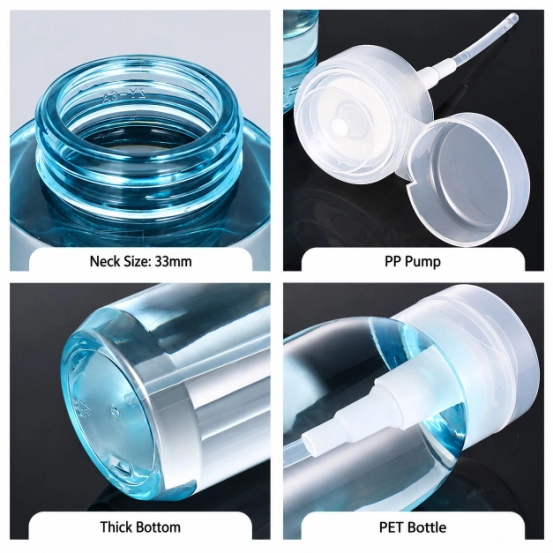
A flip cap is often considered when the user needs quick access and a simple open-pour motion. It can suit a cleanser or remover format that is dispensed onto a pad or hand, provided the opening gives enough control for the formula and the closure remains secure in the packed position.
A pump is more appropriate when measured, repeatable dosing or reduced hand contact is a priority. A spray should be treated as a separate format, not as a default substitute for a pourable remover.
| 形式 | Useful when | Questions to confirm |
| Flip cap | Fast access and pour-style dispensing fit the product | Opening control, cap seating, pad use and packed leakage risk |
| ポンプ | The brand wants controlled, repeatable dispensing | Pump pickup, output, priming, formula flow and filling-line fit |
| Spray | A fine mist is genuinely part of the product experience | Nozzle pattern, clogging risk, formula suitability and transport protection |
The table is a decision aid, not a performance claim. The same closure can behave differently with a watery bi-phase remover, an oil-rich cleanser or a more viscous emulsion.
Ask for the supplier’s recommended sample route, then test the actual formula through the selected closure. If the formula is still changing, provide the closest provisional texture and repeat the check after the final formula is available.
Check formula compatibility and transport risk
Compatibility is a project test rather than a label on a bottle. Confirm the materials that contact the formula, the closure fit, the liner or sealing elements if applicable, and the way the pack behaves after storage and handling. Look for swelling, stress whitening, odor transfer, changes in appearance, valve or pump failure and leakage around the neck. The acceptance criteria should be agreed before a bulk order, especially when the remover contains oils, solvents, fragrance or strong surfactants.
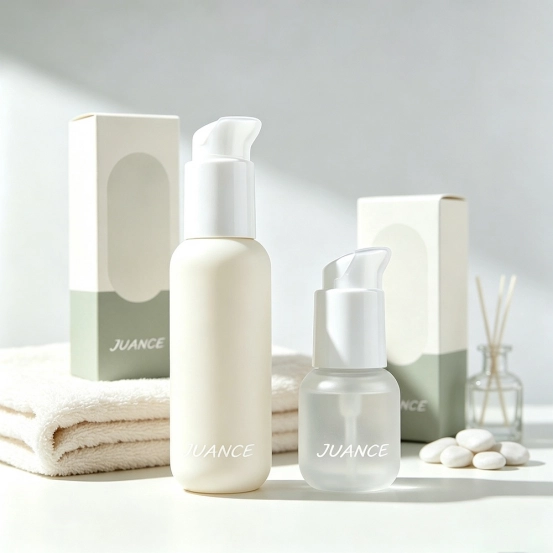
- Fill the candidate bottle with the intended formula or the closest available pilot batch.
- Check dispensing after standing, repeated opening or pumping and any expected temperature range.
- Inspect the neck, cap or pump for seepage and confirm that the packed closure remains seated.
- Run a packed-handling review that reflects the planned channel and ask which tests the supplier can document.
- Record the approved sample, formula version and packaging configuration before placing the production order.
This sequence avoids a common sourcing error: treating an empty container as approved before the filled system has been reviewed. The bottle, closure, formula, label and shipper work together. A change in viscosity, cap supplier or decoration process can justify another check, even when the outer bottle looks unchanged.
Specify capacity, shape and decoration for the channel
Capacity should follow the commercial use case. A travel or trial size, a daily retail bottle and a professional back-bar format create different expectations for portability, refill frequency and shelf footprint.
Record the target fill volume and the allowed headspace assumptions in the RFQ. Do not choose a bottle only because its nominal capacity appears close; the usable fill, closure clearance and label area still need confirmation.
Jaunce Industrial’s product range provides a concrete path for comparing those choices. The makeup-remover flip-cap bottle is a direct starting point for a pour-style brief. A custom cosmetic plastic pump bottle set is useful when the project needs to discuss pump dispensing.
A square cosmetic spray bottle can be considered only when a mist format is genuinely part of the product experience. These products support a structured model comparison; they do not prove that every formula, closure or channel will perform identically. Buyers can first review the flip-cap makeup remover bottle and then compare a custom cosmetic pump bottle set when controlled dispensing is required.
Decoration should be briefed with the use environment in mind. State the logo position, color reference, print method, finish and whether the same look must be repeated across several capacities. A large label panel may help a retail range stay legible, while a shaped bottle may require an artwork adjustment.
Request a physical decoration sample and review it on the filled or packed configuration when the label, cap and bottle work together as a shelf unit.
Build a comparable wholesale RFQ
A supplier can quote more accurately when the inquiry separates confirmed requirements from open decisions. Include the formula category and texture, target fill volume, closure preference, quantity by SKU, decoration, packing, sample count and the tests or checks that must be answered.
If the final quantity depends on launch timing, provide a range and ask how the quoted conditions change at each quantity rather than requesting an unexplained headline MOQ.
- Formula and contact conditions: water-based, oil-rich, bi-phase, surfactant or other relevant behavior.
- Dispensing: flip cap, pump or spray, with the required user motion and output expectation.
- Bottle: target fill, headspace, shape, material questions and label area.
- Decoration: color reference, print or hot-stamp requirements, finish and artwork files.
- Order plan: quantity by SKU, sample requirements, packing assumptions and target market.
- Approval: filled-sample checks, closure review, transport handling and documentation needed before release.
Keep commercial terms model-specific. The fact that one bottle listing mentions a capacity or order condition does not make that value a site-wide promise for every cosmetic bottle.
Ask Jaunce Industrial to confirm the applicable model, decoration, quantity and sample route in the response to your RFQ. That is the most reliable way to turn a broad catalog search into a comparable procurement decision.
Verified Jaunce Industrial starting points
For a makeup-remover project, Jaunce Industrial can be approached with a clear decision tree rather than a request for every bottle in the catalog. Start with the flip-cap makeup remover bottle when pour-style dispensing is the working assumption. Move to a pump bottle when the brief prioritizes controlled dosing, and reserve a spray bottle for a formula and user experience that genuinely require misting. This keeps the inquiry commercially focused and gives the supplier enough context to recommend a relevant sample.
When a spray-format alternative is appropriate, the square cosmetic spray bottle can be used as a separate discussion point. The final choice still depends on formula compatibility, dispensing performance, closure security, decoration approval and the planned packing method. Buyers can send those conditions through the Jaunce Industrial contact route rather than asking for a price without a product brief.
結論
The right makeup remover bottles wholesale decision is a filled-system decision. Define the user motion and formula behavior, select the closure that matches that use, test the filled pack for compatibility and leakage, then approve capacity, decoration and order terms.
Jaunce Industrial’s verified flip-cap makeup remover bottle, pump bottle and spray bottle options give buyers concrete starting points for a focused comparison. They do not remove the need for model-specific sampling.
Prepare the formula, quantity, decoration and validation brief before contacting the supplier so the response can address a real production scenario.
よくあるご質問
Are flip-cap bottles suitable for every makeup remover?
No. A flip cap can be a sensible option for a pour-style remover, but suitability depends on viscosity, ingredients, opening control, closure security and how the product is packed and shipped. Test the actual or closest pilot formula in the candidate bottle and confirm the filled result before approving a bulk order.
When should a brand choose a pump instead?
Consider a pump when controlled, repeatable dispensing or reduced hand contact is important to the product experience. The pump still needs to be checked for pickup, output, priming, formula flow and filling-line compatibility. A pump is not automatically better; it is a different dispensing system with its own validation questions.
What information affects a wholesale bottle quote most?
The model, closure, quantity by SKU, decoration, material or contact requirements, sample scope and packing assumptions usually affect quote comparability. Include the formula category and target fill volume as well. A supplier cannot make two quotes meaningfully comparable when one is for blank stock and the other is for a decorated multi-SKU project.
Should I request samples before final artwork?
Request a structural sample before final artwork, then approve a decorated sample after the bottle, closure and label or print area are confirmed. This reduces the risk of designing around an unapproved shape or an area that cannot reproduce the logo clearly. Keep the approved sample and artwork revision together as the project reference.