

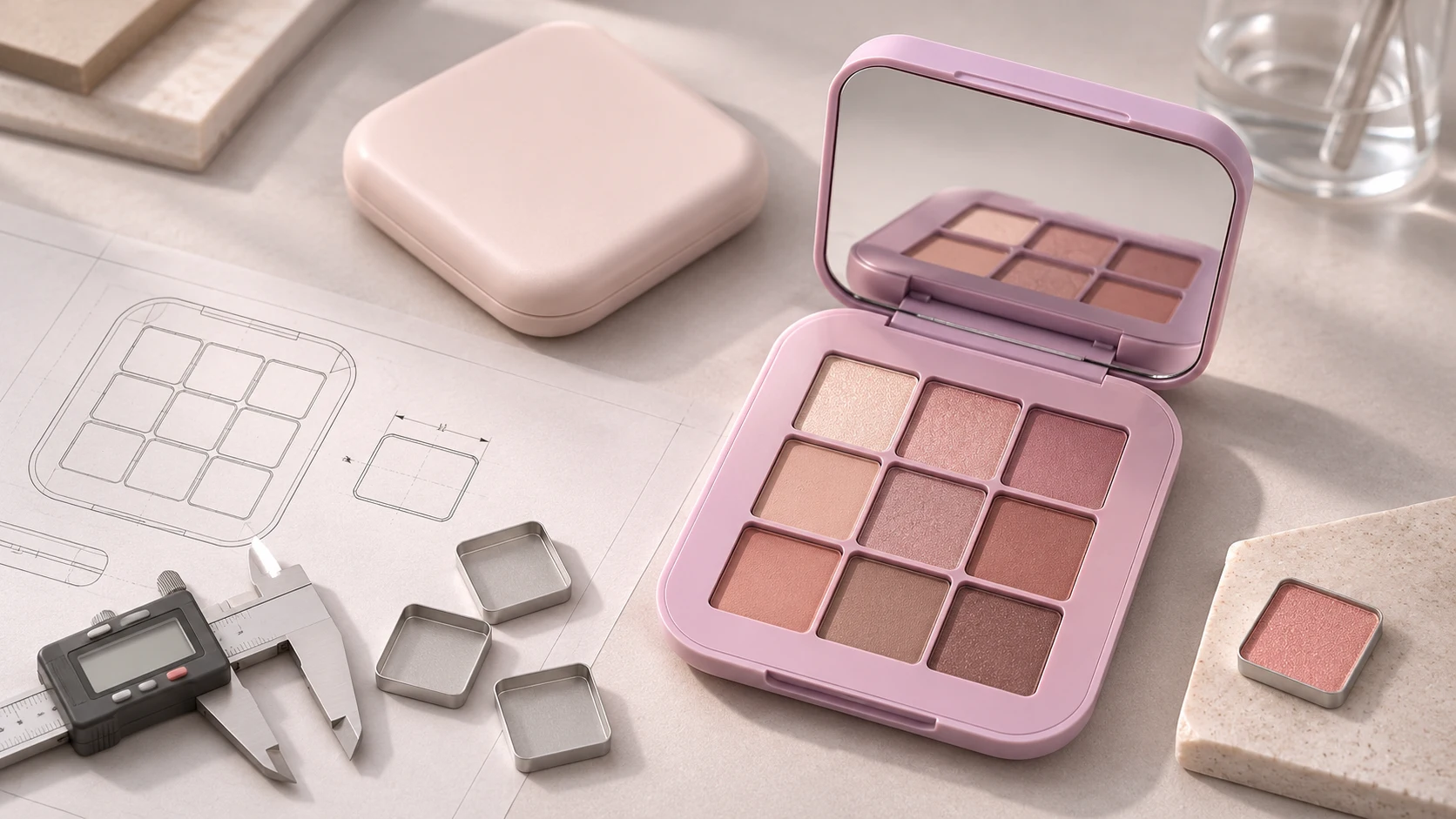
Eyeshadow palette packaging should be specified from the pans outward. Define each pan’s dimensions and retention method. Then build the grid, internal clearances, lid, mirror, hinge, and closure around the filled assembly. A palette can look correct while empty yet fail when several pressed-powder pans introduce tolerance, weight, and height variation. Approve a production-intent prototype with the actual pans and pressed cakes before decoration is finalized.
For cosmetic brands and contract fillers, the main task is not finding a universal standard eyeshadow pan size. It is documenting one controlled pan specification and proving that every position in the selected palette holds, clears, and presents that pan consistently. Multi-pan layouts create repeated interfaces, so a small mismatch can appear nine or twelve times in one pack.
Define the Pan Before the Palette
Record complete pan geometry
Do not specify a pan only by its nominal diameter or outside length. Record the outside dimensions, depth, rim profile, corner radius, wall taper, material thickness, orientation, and permissible variation. Add the intended pressed-cake height and any surface dome. Square and irregular pans need a datum that tells the assembler which edge or corner controls orientation.
The published Jaunce Industrial nine grid ABS palette lists 19.5 mm single pans and notes a related four-grid version with 30 mm single pans. Those figures belong to that series; they are not universal pan standards. A brand using pans from another source should send controlled drawings or physical samples and repeat the fit approval.
Allow for the filled cake and assembly method
The pan seat must support the chosen retention method while leaving the pressed cake clear of the lid, mirror, and neighboring pans. Adhesive, heat staking, mechanical clips, or a magnetic insert can require different contact surfaces. Confirm how the filler handles the pan, when the pan enters the palette, and whether replacement or refillability is part of the consumer use. A pan that sits level in a loose sample may tilt after adhesive thickness or powder weight is added.
Build the Grid Around Tolerance and Use
Grid layout controls more than shade count. It affects finger access, brush pickup, shade labeling, visual spacing, case size, and the amount of structure between cavities. Begin with the pan envelope and add the clearance needed for assembly and repeated opening. Then verify that the ribs or insert provide enough support without creating narrow ledges that collect powder.
A compact four-pan quad may support a focused color story and a smaller mirror, while a nine-pan grid gives more shade variety but multiplies alignment checks. An irregular arrangement can distinguish hero shades from supporting colors. Jaunce Industrial’s irregular five grid palette provides a product example of a five-compartment format and lists silk printing, hot stamping, frosting, and color injection as supported decoration processes. Confirm the exact cavity dimensions and decoration route on the quoted model.
| Structure | Útil quando | Critical approval checks |
| Fixed pan seats | The shade set and pan geometry are controlled | Cavity tolerance, adhesive or clip engagement, levelness |
| Magnetic insert | Pans may be removable or assembled by magnetic retention | Pan magnetism, polarity where relevant, holding force, rattle |
| Irregular grid | Hero shades need different sizes or visual emphasis | Orientation, spacing, fill sequence, artwork alignment |
| Mirror lid | On-the-go application is part of the routine | Mirror clearance, bonding, edge protection, hinge and closure |
Choose Fixed or Magnetic Retention Deliberately
A magnetic makeup palette is not defined by appearance alone. The retention system depends on the pan material, any metal adapter, the location and strength of the magnetic element, the distance between parts, and the loads created by carrying and impact. Ask the supplier to identify which component is magnetic and which pan constructions have been evaluated. Do not assume that every aluminum or tinplate pan will behave the same.
The Jaunce Industrial four color magnetic palette is listed as an ABS magnetic makeup palette case. Its product page identifies a 65 x 65 x 15 mm square format for eyeshadow, blush, contour, or pressed powder. Use those published details as a configuration reference and confirm pan dimensions, retention, closure, and mirror arrangement on the physical sample supplied for the project.
For fixed seats, check the adhesive or mechanical engagement after conditioning and repeated drops appropriate to the distribution plan. For a magnetic structure, check holding strength, removal force, rattle, pan rotation, and any effect of added labels or coatings. A refillable concept also needs a practical removal method that does not damage the powder or expose sharp edges.
Validate Grid Layout and Mirror Fit With a Prototype
Load every cavity with the intended pan and a representative pressed cake. Close the palette slowly and inspect clearance at the highest powder surface, pan rims, insert, mirror, and applicator space. Open it through the intended angle and check that the lid does not pull the base, the mirror remains aligned, and the closure engages without forcing the grid. Repeat the review with parts from more than one sample set.
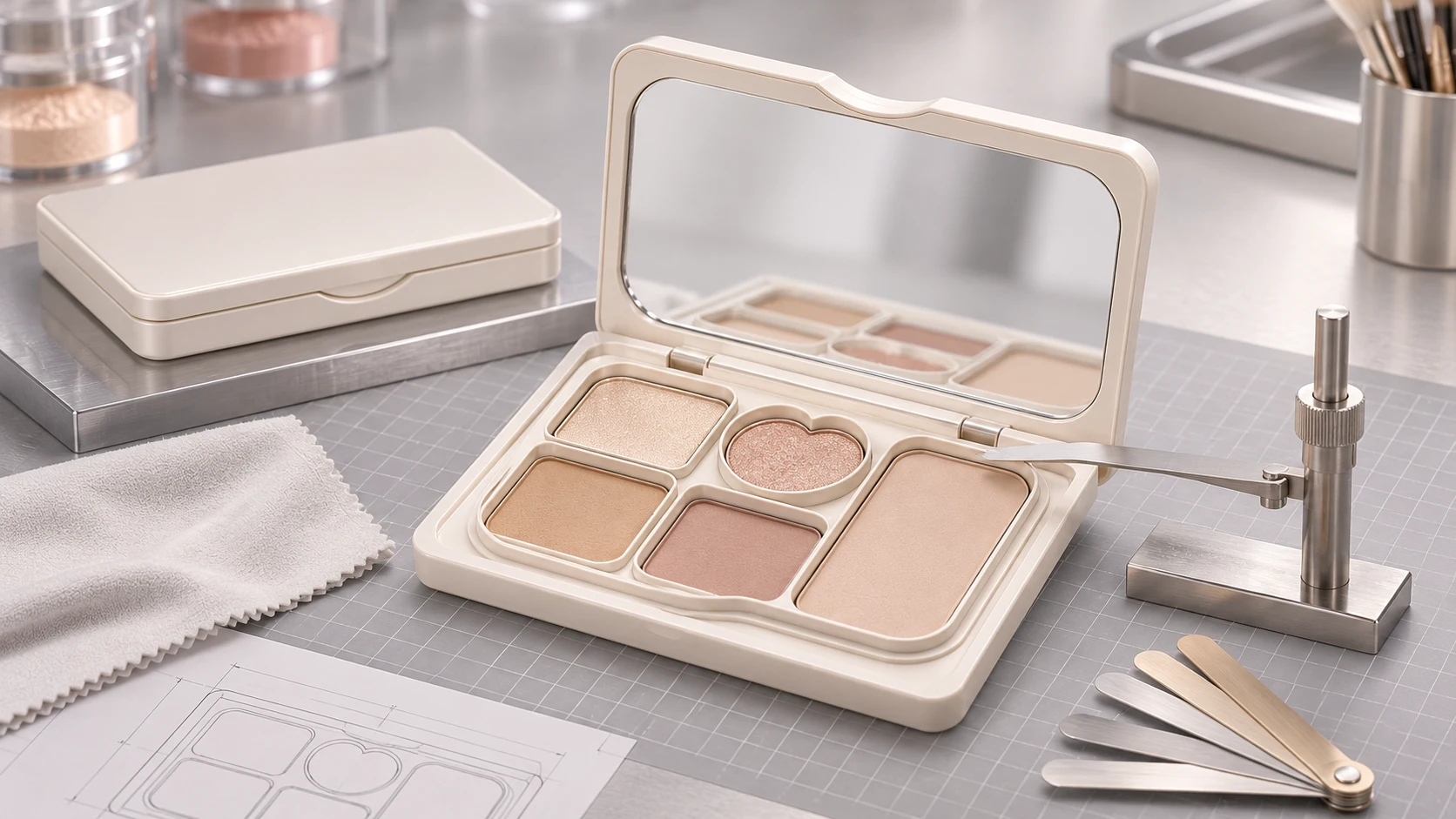
- Measure visible gaps and pan levelness at the center and outer positions of the grid.
- Inspect powder transfer to the mirror or lid after carrying and repeated opening.
- Check mirror bonding, edge condition, lid flatness, hinge movement, and latch engagement together.
- Review brush access and shade identification under normal use rather than on an empty display sample.
Mirror fit should be approved as part of the lid assembly. Specify the visible mirror area, thickness, edge treatment, placement tolerance, bonding method, and clearance from the case walls. The mirror must not interfere with the hinge, closure, pans, or any applicator. Packaging teams should also define appearance criteria for scratches, contamination, distortion, and alignment on the finished sample.
Separate This Brief From Compact Powder Packaging
A single-pan compact and a multi-pan eyeshadow palette share components, but they do not carry the same page responsibility or sampling risk. The existing compact powder packaging guide covers pan-to-compact fit, mirror, window, puff space, MOQ, and RFQ planning for pressed powder compacts. This eyeshadow brief should stay focused on repeated pan interfaces, grid architecture, magnetic or fixed retention, shade navigation, and mirror clearance across multiple cavities.
Prepare a Production Ready Palette RFQ
Send the palette supplier the pan drawing or samples, pressed-cake height, shade count, grid concept, retention method, case size target, mirror requirement, closure preference, decoration artwork, quantity by SKU, filling and assembly location, destination market, and required tests. State whether the pan source is fixed and whether refills are expected. Ask the quotation to name the exact case model and drawing revision.
Approve function before surface decoration. Keep a signed production-intent sample that represents the case, insert, every pan position, mirror, hinge, closure, color, and artwork. If the pan source, cake height, adhesive, or insert changes, repeat the relevant fit checks rather than relying on the old approval.
Conclusão
Reliable eyeshadow palette packaging starts with controlled pan geometry and a defined retention method. Build the grid around real tolerances, prove magnetic or fixed retention with filled pans, and approve mirror and closure clearance on the complete prototype. This sequence gives the filler and supplier one measurable assembly instead of a visual concept that may change during production.
To evaluate an existing Jaunce Industrial palette or a custom layout, request a palette fit review with the pan specification, shade count, layout, retention preference, mirror requirement, quantity, artwork, and assembly plan.
Perguntas frequentes
Is There a Standard Eyeshadow Pan Size
Common sizes exist, but a nominal size is not a complete fit specification. Record outside dimensions, depth, rim and corner geometry, wall profile, material, tolerances, and pressed-cake height. Approve the actual pan in every position of the selected palette.
Can Every Pan Work in a Magnetic Palette
No. Retention depends on the pan material and construction, magnetic element, distance between parts, coatings, and assembly. Test holding force, removal, rotation, and carrying behavior with the intended production pan.
When Should the Mirror Be Approved
Approve it after the grid is loaded with representative filled pans and before mass decoration. Check mirror placement, bonding, edge condition, clearance, lid flatness, hinge movement, closure, and powder transfer together.
What Should a Palette Prototype Include
Use the intended case, insert, pans, pressed-cake height, retention method, mirror, hinge, closure, applicator space, color, and decoration wherever possible. The sample should represent the assembly that the filler and brand will approve.