

Buying shampoo bottles wholesale starts with the formula and use case, not a bottle silhouette. Match viscosity, pack size, bottle stiffness, dispensing action, decoration, and order quantity before requesting pricing. Pumps suit controlled countertop dispensing; flip-tops suit shower use and squeezable bottles. PET and PETG can give a clearer, more rigid presentation, while PE and HDPE make sense when grip and squeeze behavior matter.
This guide helps hair-care brands, contract fillers, and purchasing teams compare Jaunce Industrial’s plastic bottle range and prepare a clean sourcing brief for custom shampoo bottles.
Define the Hair-Care Formula and Pack Use Case
A bottle that looks right in a rendering can still feel awkward in a wet shower or dispense a thick conditioner poorly. This first decision sets up material, closure, capacity, and testing.
Record where the pack will be used, how the formula moves, and whether the customer will pump, squeeze, or invert it. That prevents the familiar mistake of approving the bottle first and trying to make the formula behave later.
Map Viscosity and Dispensing Needs by Product Type
Standard shampoo may work with a pump, disc-top, or flip-top, but dense conditioner can need a wider flow path or a comfortably squeezable bottle. Body wash adds one-handed opening and wet grip to the brief.
A family look is still possible: keep the visual language, then adapt closure or bottle stiffness by formula instead of forcing every SKU into one component set.
Compare PET, PETG, PE, and HDPE by Pack Behavior
PET and PETG suit concepts that call for clarity, visible color, and a more rigid wall. PE and HDPE feel different in hand and can suit squeeze-led dispensing.
A resin name alone does not settle compatibility: formula, fill conditions, closure fit, and storage all matter. Shortlist the required behavior, then approve the actual filled formula.
| Buying condition | Likely direction | Confirm on the sample |
|---|---|---|
| Clear or translucent shelf presentation | PET or PETG candidate | Color, wall feel, label or print result |
| Squeeze-led shower use | PE or HDPE candidate | Grip, recovery after squeezing, cap operation |
| Countertop dispensing | Rigid bottle with pump | Priming, dose feel, lock, dip-tube reach |
Specify the Dispensing System: Pump, Flip-Top, or Disc-Top
The closure is the daily interface between formula and customer. It also affects filling, shipping, storage, and perceived quality. After narrowing the material, compare dispensers with the real product, not water.
A pump may struggle with a dense formula; a flip-top can be awkward on a rigid bottle. Ask which option gives this formula an easy, repeatable exit.
Evaluate Pump Fit and Formula Delivery
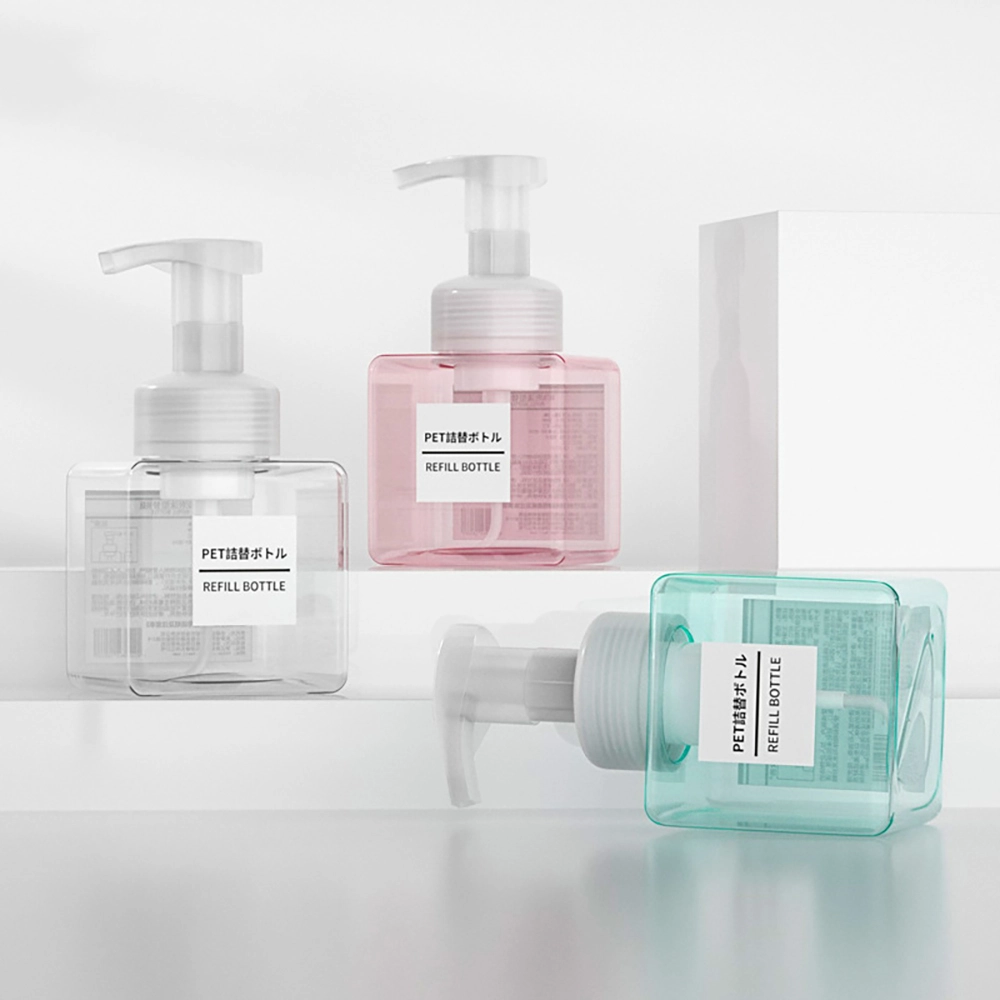
A lotion-style pump can make a 300 ml or 500 ml family pack convenient at a sink or shower niche. A 300 ml and 500 ml PET bottle with a PP pump gives buyers a concrete pump-format reference for shampoo or body wash.
Check neck fit, lock position, dip-tube length, priming, output consistency, and end-of-use residue with the intended formula; viscosity changes the dispensing feel.
Evaluate Flip-Top and Disc-Top Performance in Shower Use
Flip-tops pair naturally with a bottle designed to flex. The 280 ml and 350 ml curved PE bottle is a relevant squeeze-format reference for shampoo and conditioner. Disc-tops offer a related one-handed action with a different profile.
Check opening force, flow, clean cutoff, cap retention, and leakage after repeated cycles. A shower closure that needs two dry hands will not improve at home.
Set Pack Capacity and Filled-Product Compatibility
Capacity shapes bottle proportions, shipping, label area, usage duration, and price position. It also changes how the closure feels in relation to the pack. Once the dispenser direction is clear, choose capacity around channel and customer routine, then verify the filled system. Decoration comes later; artwork cannot rescue a package that dispenses badly or tips at the sink.
Build the Size Architecture Around the Sales Channel
A 200-350 ml bottle can fit core retail and salon concepts, while 400-500 ml formats may serve family-size ranges. These are planning bands, not rules. Consider shelf height, e-commerce cartons, usage rate, and matching shampoo/conditioner silhouettes.
One hero capacity is often cleaner than three launch sizes, especially when every color creates another SKU.
Approve the Bottle, Closure, and Formula as One System
Use production-intent formula for compatibility work. Check dispensing after storage, closure cleanliness, distortion, decoration adhesion, and leakage in shipping orientations.
Brand, filler, and packaging partner should define the protocol because fill and distribution conditions vary. Record the accepted bottle, closure, color, artwork, and formula version together. A loose desk sample is not an approval record.
Align Decoration Scope, SKU Count, and MOQ
Decoration and minimum order quantity are linked. A stock mold with a label differs from a custom color with printed passes, coated components, and several fragrances.
Ask for MOQ by exact SKU and decoration route, not one number for the shampoo line. This exposes where variety creates cost or inventory pressure before artwork approval.
Match Artwork to the Usable Print Area
Silk-screen printing, hot stamping, coating, labels, and custom color can create different results on the same form.
Jaunce Industrial’s OEM/ODM packaging service gives buyers a route to discuss those decoration choices. Curved shoulders, waist details, and grip zones reduce usable graphic area, so send vector artwork and request a placement drawing.
Review small legal copy at actual size; a restrained screen design can become a gray blur on a physical bottle.
Confirm MOQ for Each Bottle-and-Decoration Configuration
Some Jaunce Industrial hair-care packs publish a 10,000-piece MOQ, including the 250 ml and 450 ml PETG shampoo bottle and a 280 ml and 350 ml curved PE option. Treat those figures as model-specific.
The PETG format supports custom color and decoration, while the PE format gives buyers a squeeze-led route with flip-top or screw-cap configurations.
This lets a sourcing team compare a rigid visual direction with a squeezable shower format without assuming they share the same component or final commercial terms.
For a clear, rigid presentation, review the Jaunce Industrial 250 ml and 450 ml PETG shampoo bottle. It provides a model-specific reference for custom color and decoration.
Jaunce Industrial’s quality process includes raw-material sampling, inspection during production, and inspection before packing and storage.
Buyers should define clear acceptance requirements for the selected bottle, closure, filled formula, decoration, final artwork, packing method, carton marking, destination, and approval owner.
Prepare a Production-Ready Shampoo Bottle RFQ
A vague request for plastic shampoo bottles wholesale triggers more questions, not a faster price. A useful RFQ ties the product, component set, customization, market, and schedule together. It also identifies fixed details and open specifications.
After the material, closure, and size decisions above, seven lines are often enough to start a productive exchange.
List the Inputs That Change Cost and Feasibility
- Product type and a brief description of viscosity
- Target capacity and preferred bottle behavior
- Pump, flip-top, disc-top, or open recommendation
- Quantity per SKU, including each color or fragrance
- Color reference, logo file, and decoration preference
- Destination country and intended sales channel
- Target delivery date and sample decision deadline
Separate Fixed Requirements From Open Specifications
Mark must-have details separately from preferences. If the silhouette is fixed but the closure is open, say so. If the launch date matters more than a special color, say that too. A hair care packaging supplier can respond more usefully when the trade-offs are visible.
Ask the quotation to identify the proposed bottle, closure, material, decoration, MOQ, sample route, and packing assumptions so competing offers describe comparable configurations.
Вывод
The best custom shampoo bottles wholesale project starts with three decisions: how the formula moves, how the customer dispenses it, and how many decorated SKUs the launch can carry.
Choose material by clarity and squeeze behavior, match the closure with the actual formula, and approve the filled system before mass production. Then connect decoration and MOQ at configuration level.
Send capacity, quantity, artwork, destination, and timing to Jaunce Industrial when you are ready to request a packaging quotation.
ЧАСТО ЗАДАВАЕМЫЕ ВОПРОСЫ
Q1: Are PET shampoo bottles suitable for every formula?
A: No. PET or PETG can be a strong candidate when clarity and rigidity matter, but the actual shampoo, colorants, fragrance, fill conditions, closure, and storage plan must be evaluated together.
Q2: Is a pump or flip-top better for conditioner?
A: It depends on viscosity and use. A pump can give controlled dispensing if the formula moves through it consistently. A squeezable bottle with a flip-top may feel easier for a very dense conditioner. Test the real formula.
Q3: What is the MOQ for shampoo bottles wholesale?
A: MOQ belongs to a specific bottle, closure, color, and decoration plan. Some relevant Jaunce Industrial products publish a 10,000-piece MOQ, but buyers should request confirmation for the selected configuration and each SKU.
Q4: Can shampoo and conditioner use the same bottle?
A: They can share a silhouette when both formulas work with the selected bottle and closure. Different closures or bottle stiffness may still be sensible, particularly when the conditioner is much thicker.
Q5: What information does a shampoo bottle manufacturer need for a quote?
A: Send the product type, capacity, formula behavior, preferred closure, quantity per SKU, color or artwork, destination country, and target date. Mark any fixed requirements and note where you are open to a recommended bottle or closure.