

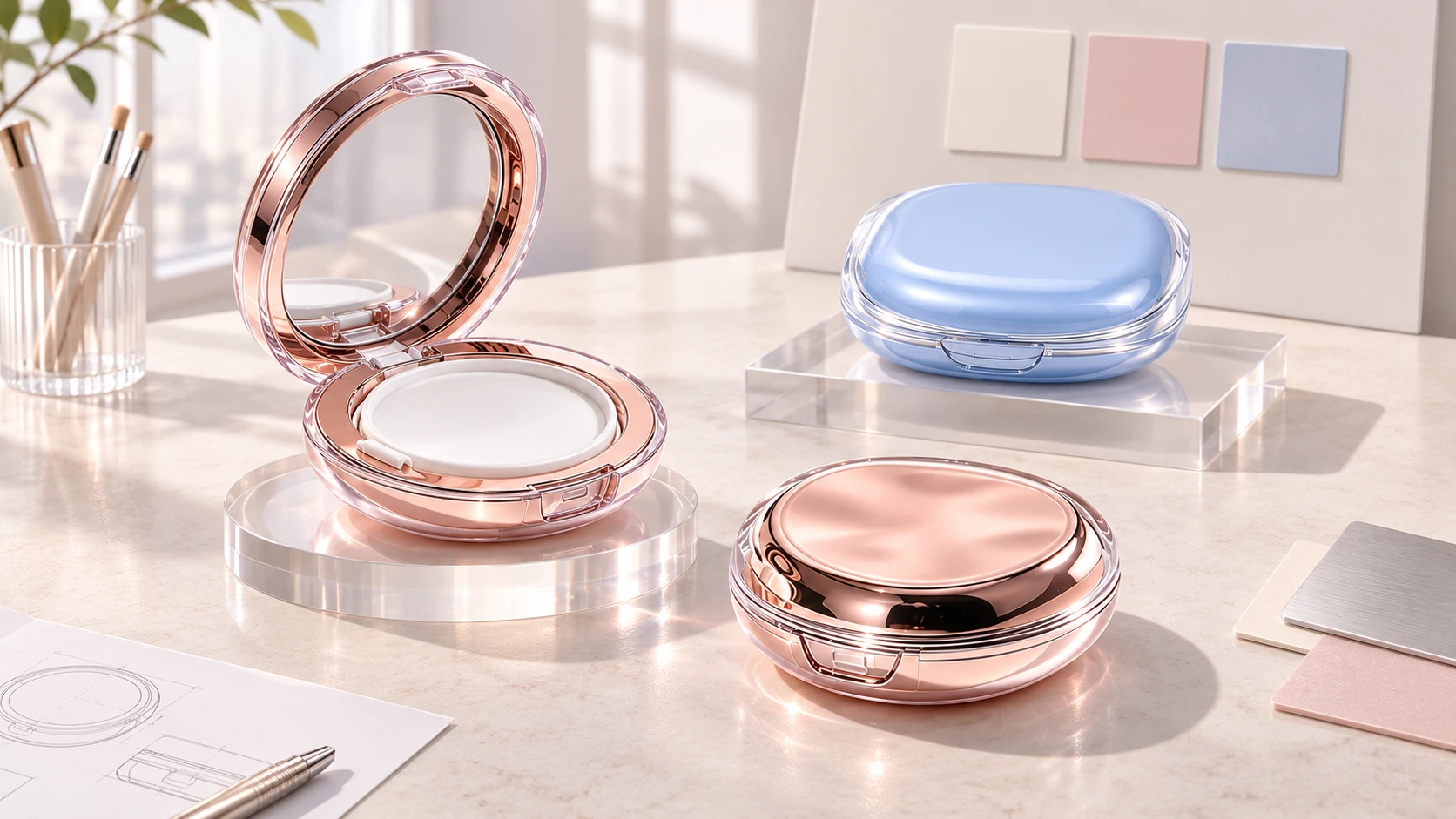
Choose cushion foundation packaging as an assembled system, not as an attractive outer compact. The outer case, latch, hinge, mirror, puff deck, sealing lid, refill cup, sponge or mesh, and formula must work together. A good sourcing process begins with formula and refill requirements, then confirms sealing, fit, use, decoration, and distribution performance on production-representative samples.
Start with the cushion package architecture
A cushion compact contains more interfaces than a pressed-powder compact. Each interface can affect formula protection, consumer handling, or refill replacement. Before comparing shapes and finishes, ask the supplier for an exploded drawing or component list and identify which parts are included in the quoted assembly.
Outer case hinge latch and mirror
The outer case protects the internal system and carries most of the visual design. Check opening force, latch engagement, hinge movement, mirror retention, and clearance around the puff deck. A closure that feels secure at first assembly should also remain usable after repeated opening, temperature conditioning, and normal handling.
Refill cup or inner tray
The inner component holds the formula-delivery system and may be permanent or replaceable. Confirm its outer diameter or profile, overall height, locating features, retention method, flange, orientation, and removal method. A refill described by fill weight alone is not interchangeable with another refill of the same nominal weight.
Sealing lid and puff deck
The secondary lid separates the wet formula from the puff area and helps limit exposure during storage and daily use. Review the seal contact, opening tab, hinge or snap feature, and the space available when the puff is stored. The puff should not prevent the inner lid or outer case from closing fully.
Match the formula to the delivery system
Sponge and mesh systems behave differently
A porous sponge stores formula throughout its structure, while a mesh system controls access through a screen above the reservoir. The choice affects loading, pickup, dose feel, filling method, and how the package responds as formula is used. Confirm the supplier’s recommended component system for the formula rather than substituting a sponge or mesh based only on appearance.
Fill weight does not define physical fit
A stated fill weight describes the intended amount of formula, not the full geometry of the refill. Formula density, absorbent-media volume, reservoir shape, headspace, and filling process can change the relationship between grams and occupied volume. Establish the target fill and filling method with the formulator and packaging supplier before locking the cup and media.
Control drying leakage and contamination paths
Wet cushion formulas need a package that limits unwanted exposure and retains formula under intended distribution and use conditions. The critical paths are usually the seal around the inner lid, interfaces in the refill cup, the outer latch, and any gap created by a mis-seated puff. Required performance depends on formula, viscosity, volatile content, orientation, temperature, and service life.
- Condition filled samples at relevant temperatures, then inspect mass change, odor, texture, and visible leakage.
- Check upright, side, and inverted orientations when those positions can occur in shipping or consumer use.
- Repeat opening and closing to see whether the inner seal, latch, and hinge maintain their intended function.
- Inspect formula contact areas, decoration, mirror, adhesive, and puff after compatibility exposure.
Verify refill fit with controlled dimensions
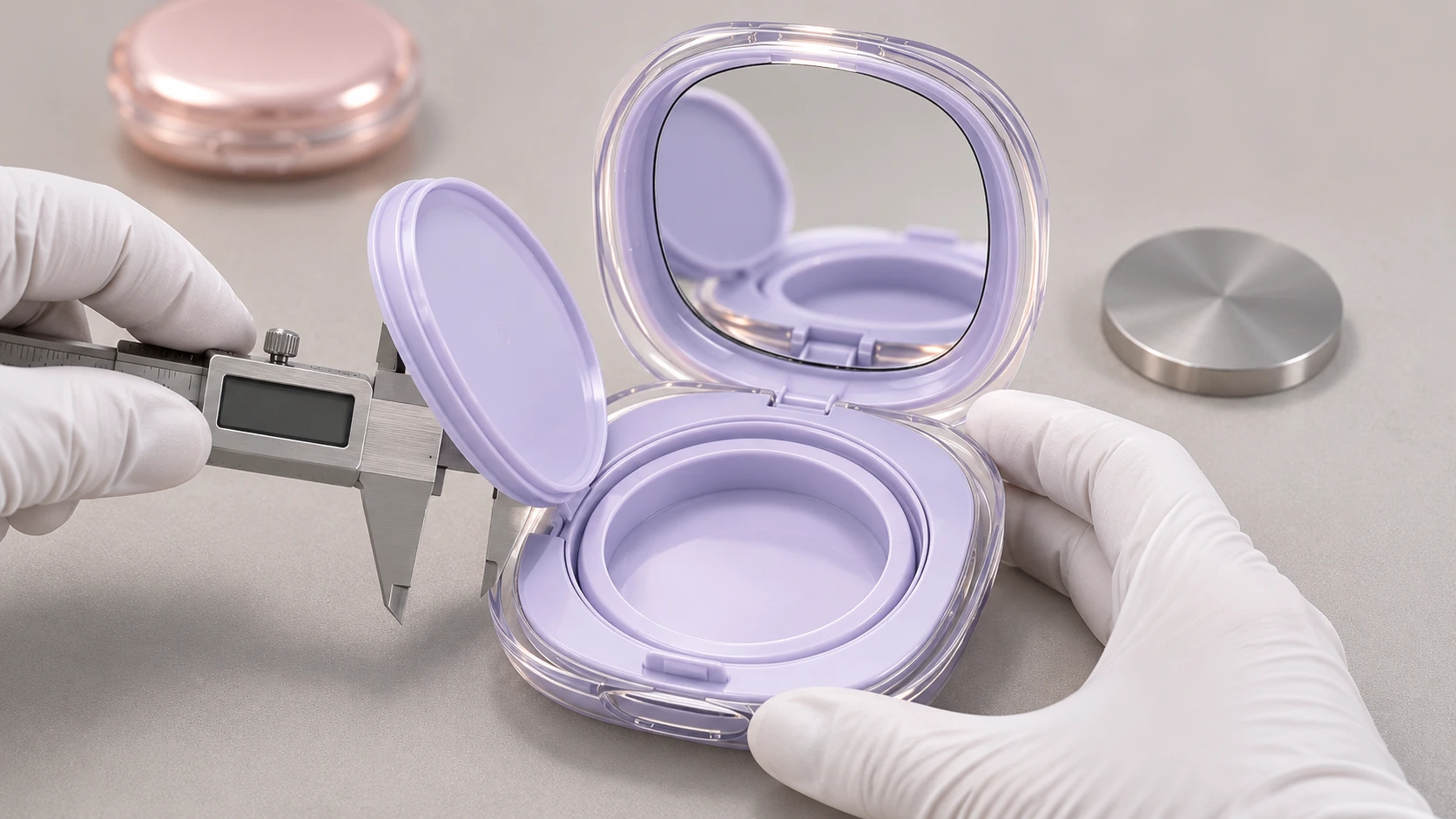
Refill fit should be controlled through drawings and functional samples. A verbal statement that two refills are the same size is not enough for a refill program that may continue across multiple production lots.
| Fit point | Почему это важно | Approval check |
| Outer profile | Determines whether the refill enters the case without interference | Compare drawing dimensions and insert production samples |
| Retention feature | Prevents looseness while allowing the intended removal method | Measure insertion and removal behavior after conditioning |
| Overall height | Affects inner-lid and outer-case closure | Close the assembled pack with the specified puff in place |
| Orientation key | Aligns tabs, seals, graphics, or removal points | Confirm correct and incorrect insertion behavior |
| Seal interface | Limits formula migration and drying | Test filled assemblies in relevant orientations and temperatures |
Plan puff space and mirror usability
Puff diameter, thickness, edge binding, ribbon, and compression affect how the package closes and how the applicator is removed. Confirm that the ribbon remains accessible, the puff does not drag across the seal, and the mirror is usable at the intended opening angle. If a thicker or specialty puff will be sourced separately, include the final applicator in the package approval test.
Choose shape material and decoration after function
Round, square, double-layer, recessed-lid, and transparent-rim designs can support different brand directions, but visual decisions should follow the approved architecture. Decoration may include electroplating, color, silk-screen printing, hot stamping, or UV printing when available for the selected model. Confirm artwork area, color standard, adhesion, abrasion resistance, and compatibility on decorated samples.
This structure is different from a dry pressed-powder pan. Buyers working across both formats can use the compact powder packaging guide to separate pan-fit requirements from wet-cushion refill and seal requirements.
Use existing cushion case models as starting points
Jaunce offers an ABS round recessed air cushion case with a mirror and decoration options that include electroplating colors, silk printing, hot stamping, and UV-printed logos. Its published information supports appearance and decoration selection; the exact refill, sealing system, and dimensional fit should be confirmed for the chosen configuration.
A second Jaunce option is the ABS double-layer snap air cushion case for cushion foundation and BB cream. It uses a rounded-square form with a transparent outer rim and pastel inner shell. The two products provide different exterior silhouettes, so brands can compare visual direction without assuming that internal refills are interchangeable.
Sampling checklist before an order
- Formula type, viscosity, density, target fill, and filling method
- Sponge or mesh specification and the complete refill-cup drawing
- Seal design, inner-lid operation, puff dimensions, mirror, latch, and hinge
- Decoration process, artwork area, color target, and decorated-sample approval
- Compatibility, leakage, drying, temperature, transit, repeated-use, and refill-replacement checks appropriate to the launch
Вывод
Cushion foundation packaging succeeds when the formula, refill, seal, puff, and outer case are approved as one controlled system. Start with the wet-package architecture, verify refill geometry and closure stack-up, then select shape and decoration. This order of decisions protects the formula and gives consumers a compact that closes, dispenses, and refills as intended.
To compare an available case with your formula and refill plan, send the project requirements to Jaunce including fill target, delivery system, puff, decoration, quantity, and destination market.
Frequently asked questions
What parts are included in cushion foundation packaging
A system may include an outer hinged case, latch, mirror, puff deck, secondary sealing lid, refill cup, sponge or mesh, and puff. Confirm the supplier’s exact component list for each model.
Can any cushion refill fit any compact
No. Refill profiles, heights, retention features, orientation keys, and seal interfaces vary. Compare drawings and approve physical samples in the final case.
How can a brand reduce cushion foundation drying
Select a compatible refill and seal system, control all interfaces, and test filled packages under relevant time, temperature, and orientation conditions. Performance depends on both formula and package.
When should the puff be selected
Select the production puff before final package approval. Its diameter and thickness can affect inner-lid access, closure stack-up, storage space, and consumer handling.