

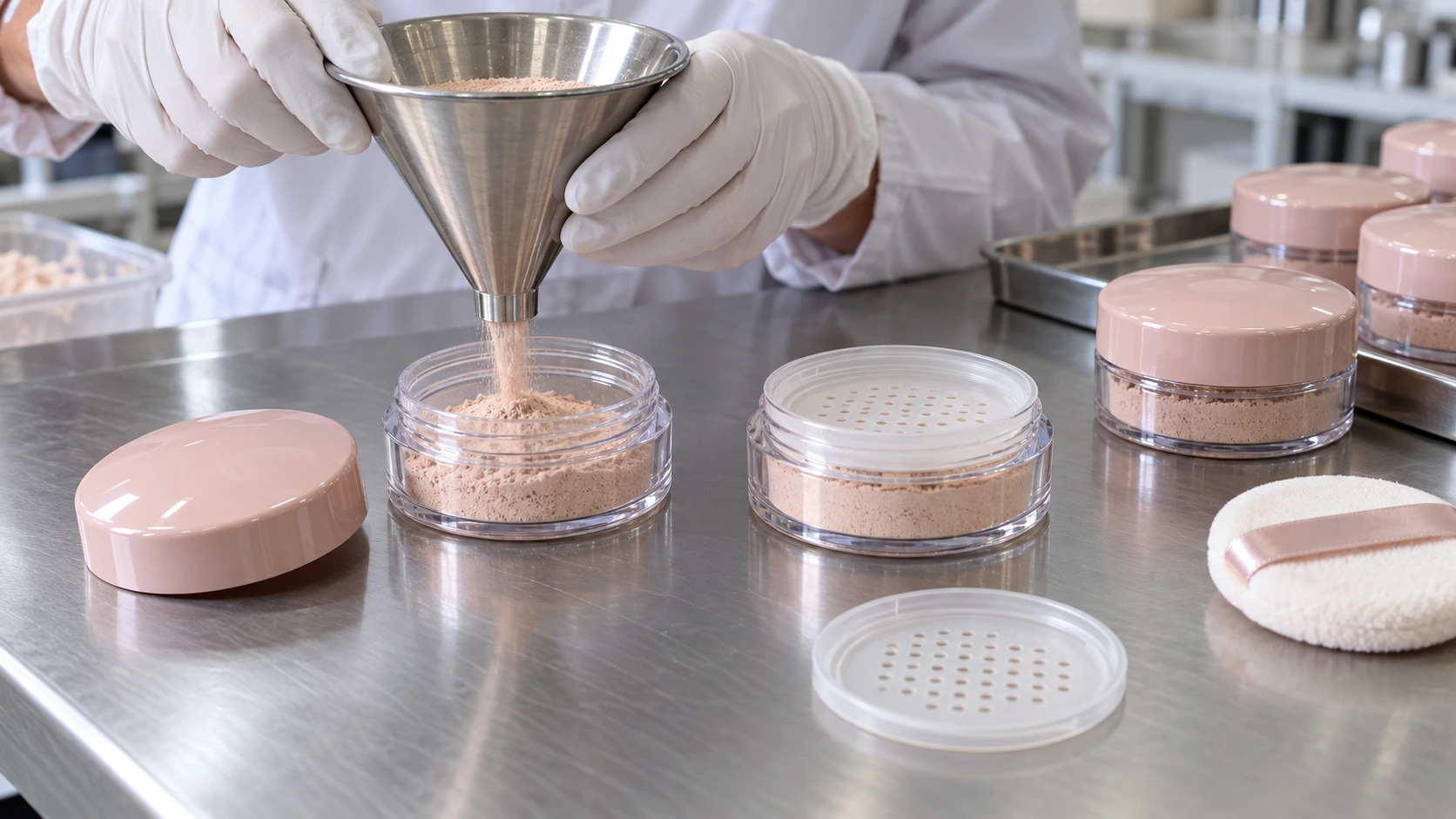
Loose powder packaging works only when the jar opening, sifter, formula, and filling process are developed as one assembly. The mouth must give the filler enough access, the sifter must remain secure in the jar, and the opening pattern must release a useful amount without flooding the puff area. Capacity, fill weight, powder behavior, and assembly sequence therefore need approval before color or decoration.
A catalog jar can still fail on the filling line or in a handbag. Start with powder flow and target dose, then confirm access, retention, headspace, cleanliness, and repeated use on filled samples.
Start With Powder Behavior and the Intended Dose
Record the product type, fill weight, bulk density range, particle-size distribution where available, and whether the powder bridges, compacts, clings through static, or absorbs moisture. These properties affect occupied volume and sifter flow. Two powders at the same weight may need different jar volumes and opening patterns.
Define how the user should access the product. A puff-loaded sifter, a shake-to-tray routine, and a brush-dip jar create different dose and mess risks. Specify whether one or two shakes should expose a light working amount, whether the sifter can be closed, and whether the puff is stored above the powder. The jar architecture should support that routine without requiring the consumer to remove a fitted insert.
Set the Jar Opening From Filling and Assembly Needs
Give the filler a usable mouth
The jar opening must accommodate the filling nozzle or funnel, positional tolerance, and any dust-extraction arrangement used by the contract filler. Ask for the minimum clear opening at the actual insertion depth, not only the outside neck diameter. Threads, shoulders, undercuts, and decorative overhangs can reduce working access even when the top view looks generous.
Confirm whether powder is filled before the sifter is installed, whether the sifter arrives loose or preassembled, and what press or fixture installs it. Many projects fill through the open jar and fit the sifter afterward, but the sequence depends on the component design and filling line. The supplier and filler should approve the same drawing and sample assembly.
Protect the sealing land and headspace
Keep powder away from the surfaces that retain the sifter or seal against a liner, inner lid, or cap. Dust on those interfaces can reduce seating consistency and create visible contamination. Define a clean-zone requirement and a method for removing loose powder before closing. The filled powder level must also leave enough headspace for the sifter, puff, internal lid, and movement during transport.
Do not convert nominal jar volume directly into fill weight. Use the commercial powder’s bulk density and the production fill method, then review settling and aeration. Approve the practical fill range in grams together with the intended headspace and component stack.
Treat the Sifter and Jar as a Matched Assembly
Control fit and retention
Sifter fit depends on more than one diameter. The drawing should identify the jar seat, sifter outside profile, engagement feature, insertion depth, material, and relevant tolerances. A snap or interference fit that is too loose can lift during use; one that is too tight can deform the sifter, stress the jar, or demand excessive assembly force.
Measure installation force and retention on multiple components from representative production lots. Inspect for rocking, gaps, distortion, and damage after temperature conditioning and transport simulation. If the design uses a removable or rotating sifter, define the intended action and resistance separately from the permanent retention of its supporting parts.
Match aperture design to the powder
Hole diameter alone does not determine flow. Hole count, total open area, plate thickness, edge shape, powder cohesion, particle distribution, static, humidity, and the user’s shaking motion all contribute. A mesh or elastic sifter behaves differently from a rigid perforated insert. Trial more than one opening pattern when the formula is dusty, highly fluid, or prone to bridging.
| Interface | Main risk | Filled-pack approval |
| Jar mouth and filler | Restricted access or powder on threads | Nozzle clearance, fill accuracy, clean closure zone |
| Sifter and jar seat | Lift-out, distortion, or high assembly force | Installation force, retention, gaps, conditioning |
| Sifter and powder | Flooding, bridging, or inconsistent dose | Shake test, tray loading, static and humidity review |
| Cap and inner stack | Compression, leakage, or puff interference | Closed-pack clearance and transport trial |
Design the Filling Sequence Before Decoration
Run a production-intent trial that includes container feeding, powder dosing, dust removal, sifter installation, cap or inner-lid application, coding, and final inspection. Record where powder escapes and which surfaces the operator or automation must touch. A jar that fills accurately but requires manual cleanup at every station may not meet the commercial process target.
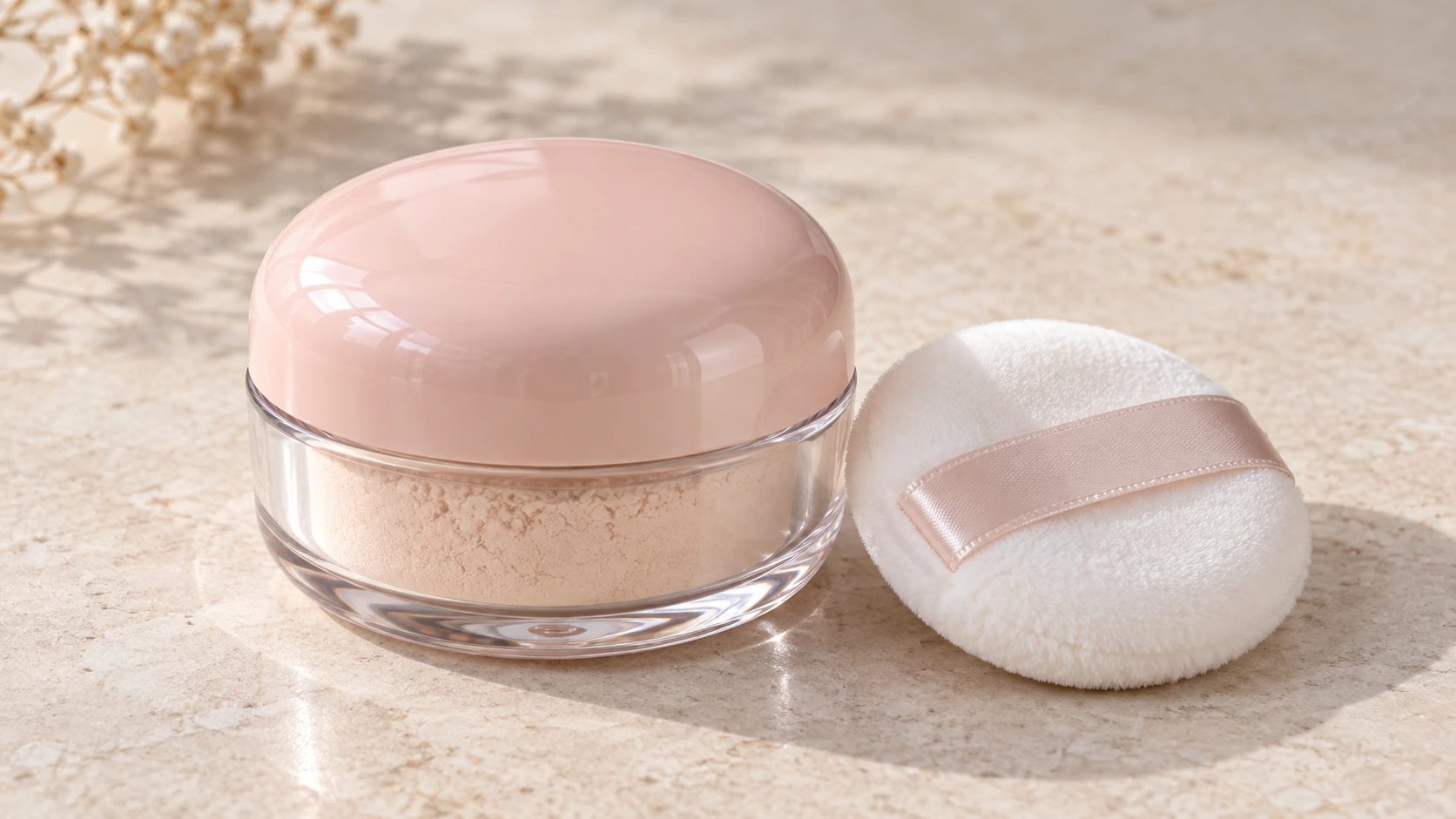
Evaluate fill accuracy in weight while reviewing the occupied volume. Define acceptable fill weight, visible headspace, and powder on the jar or sifter. If static is significant, test the filler’s process controls before launch.
- Check the empty component dimensions and the filled assembly from more than one production lot.
- Test upright, side, and inverted orientations when they reflect distribution or consumer storage risk.
- Repeat shaking, opening, puff loading, reclosing, and carrying to observe migration above the sifter.
- Inspect decoration only after dust cleanup, handling, and closure assembly have been demonstrated.
Separate Loose Powder From Pressed Compact Requirements
Loose powder and pressed powder may share a round outer form, but their internal jobs are different. Loose powder needs controlled movement through a sifter or opening and often a tray or puff space. Pressed powder needs a pan, a stable seat, and clearance around the cake. Do not accept a compact case as a loose-powder solution unless the internal structure is specifically designed and tested for the loose formula.
CosmePak’s pressed-powder compact guide provides a complementary reference for pan fit, mirror, and compact closure decisions. Keep that specification separate from the new loose-powder jar brief so quotations do not mix pan dimensions with sifter requirements.
Build a Loose Powder Packaging Supplier and Filler RFQ
Jaunce Industrial includes loose-powder formats in its ассортимент упаковки для косметики. One published loose-powder jar model lists ABS and AS, customized color and surface-finish options, and a model-specific MOQ. Use those details as a starting point, then confirm the exact jar, sifter, inner parts, cap, materials, decoration, and current commercial terms on the quotation.
Send Jaunce Industrial and the filler the powder type, bulk density range, target fill weight, desired consumer dose, sifter style, puff or tray requirement, jar opening constraints, filling location, assembly sequence, quantity by SKU, decoration, destination market, and test plan. Include the filler in sample approval because nozzle access, dust control, installation tooling, and line speed cannot be resolved by appearance samples alone.
Retain an approved filled assembly with the controlled drawing revision and agreed acceptance criteria.
Вывод
Reliable loose powder packaging begins with the powder and filling line. Size the mouth for real access, keep sealing and retention surfaces clean, match the sifter fit and opening pattern to the formula, and verify headspace and component clearance. Approve the filled assembly through filling, installation, transport, and repeated-use trials before final decoration.
To review a loose-powder project with Jaunce Industrial, contact the packaging team with the powder properties, fill weight, jar and sifter needs, filling process, quantity, decoration, and destination market.
Часто задаваемые вопросы
How large should a loose powder jar opening be?
It should provide verified clearance for the filler nozzle or funnel, positional tolerance, cleanup, and sifter-installation tooling. Use the filler’s equipment requirements and the component drawing rather than a generic diameter rule.
Can a sifter be chosen by hole diameter alone?
No. Hole count, total open area, insert thickness, material, powder flow, static, humidity, and user motion all affect dispensing. Approve the sifter with the commercial powder in a repeated-use trial.
Should the sifter be installed before or after filling?
Many jars are filled first and fitted with the sifter afterward, but the correct sequence depends on the jar, insert, and filling line. Confirm the sequence, tooling, cleanliness, and retention with both supplier and filler.
What should be included in a loose powder packaging sample test?
Include fill accuracy, headspace, dust cleanup, sifter installation and retention, cap clearance, leakage or migration, transport conditioning, shake-to-dose behavior, puff loading, repeated opening, and decoration appearance after handling.