

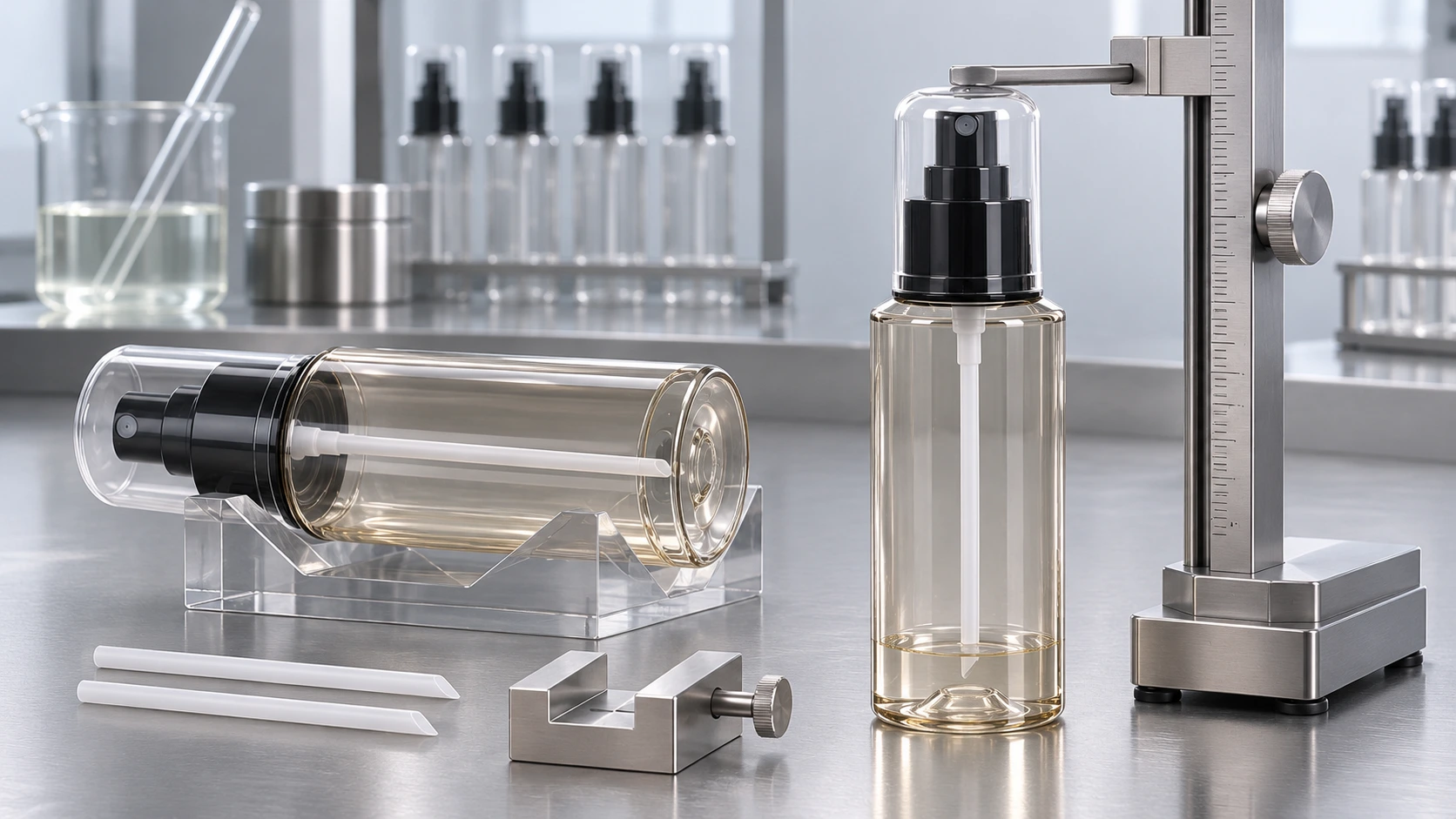
To measure dip tube length correctly, define one reference plane at the closure gasket or sealing interface, measure the bottle’s internal depth from that plane, and subtract the planned clearance between the tube tip and the inside base. Then cut and test the actual pump or sprayer on a filled bottle. The drawing must state the reference because measuring only the loose plastic tube can omit the section captured inside the pump.
This method applies to cosmetic pump and spray bottles, but the final length is model-specific. Bottle push-up, shoulder geometry, tube flexibility, formula viscosity, pump inlet design, and cut angle can all change pickup. A calculated dimension is therefore a trial target, not final approval.
Define the Measurement Reference First
Packaging teams often use FBOG, meaning From Bottom of Gasket, to communicate dip tube length. Supplier conventions and component drawings can still differ, so label the exact gasket surface or sealing plane and the exact tube tip in the drawing. Record whether the quoted dimension includes the tube section inserted into the pump body. Both the bottle supplier and pump supplier should review the same datum.
The matching bottle measurement runs from the agreed sealing plane to the lowest usable inside point. Do not substitute the outside bottle height. The base may have a push-up, curved heel, or molded variation, and the tube may sit off center because the pump inlet is not aligned with the bottle’s deepest point.
Measure and Cut the Dip Tube in Seven Steps
- Assemble the intended pump or sprayer with its gasket, closure, and uncut tube. Do not measure a different closure that only shares the neck finish.
- Identify and mark the agreed sealing datum on the closure drawing or physical sample.
- Measure from that datum to the inside base of the production-intent bottle at the tube’s expected landing point.
- Select a trial bottom clearance based on the pump inlet, tube flexibility, bottle geometry, and formula. Avoid adopting one universal gap.
- Transfer the resulting target length to the assembled pump and mark the tube without pulling it from its seated position.
- Make a clean cut using the specified orientation. An angled tip can reduce the risk of a flat end sealing against the base, but it still requires testing.
- Install the component, tighten it to the intended position, and inspect whether the tube is free, lightly curved, sharply bent, or pressed against the floor.
A simple working relationship is target tube length equals internal reference depth minus planned bottom clearance. Keep the calculation in the controlled specification with the measurement points shown. If the bottle and pump suppliers use different datums, reconcile them before ordering cut tubes.
Set Bottom Clearance for the Package and Formula
A tube that is too short leaves a larger residual volume and may lose prime when the bottle is tilted. A tube that is too long can buckle, curl away from the lowest point, press its tip closed against the base, or create inconsistent assembly. The acceptable range depends on the bottle and dispensing system, so test more than one trial length when the geometry is uncertain.
Thin toner in a fine mist sprayer can move readily toward the inlet, while lotion, shampoo, and body wash may require a different pickup condition. Viscous or stringy formulas can expose restrictions that water trials miss. Use the commercial formula or a controlled equivalent agreed by the formulator, and repeat the test after relevant storage conditioning.
| Observed condition | Likely length or geometry issue | Sample check |
| Early loss of prime | Tube may be short or landing above the lowest liquid area | Test upright and intended dispensing angles |
| Sharp bend or kink | Tube may be long or too stiff for the bottle path | Inspect assembled tube shape through a clear trial bottle |
| Intermittent output | Tip may seal against the base or formula may restrict pickup | Compare cut angle, clearance, viscosity, and recovery |
| High residual product | Landing point may miss the lowest usable area | Weigh filled and exhausted packs under the use protocol |
Account for Pump and Sprayer Differences
The dip tube is only one part of the dispensing path. The inlet, pump chamber, valves, actuator, nozzle, and closure seal determine how the system primes and recovers. For a fine mist sprayer, evaluate spray formation, sputtering, and performance as the liquid level falls. For a lotion pump, evaluate prime count, complete stroke, output recovery, and whether the formula draws through the inlet without cavitation or clogging.
Jaunce Industrial'ın PET fine mist spray bottle range is published in 75 ml, 100 ml, 150 ml, and 200 ml sizes for toner, moisturizing water, rehydration solution, and light moisturizing lotion. Its 300 ml and 500 ml PET lotion bottle page lists 28/410 pumps for the 300 ml bottle and 32/410 pumps for the 500 ml bottle. These are useful examples of why tube length must be matched to the exact bottle, capacity, and closure rather than ordered by product category alone.
Validate the Cut With Filled Samples
Prepare several cut lengths around the calculated target. Assemble each closure to the intended torque or application condition, then fill the bottle to the production target. Record priming, output over repeated strokes, orientation, leakage, spray or stream quality, near-empty pickup, and residual product. Include multiple bottles and pumps so one favorable sample does not define the specification.
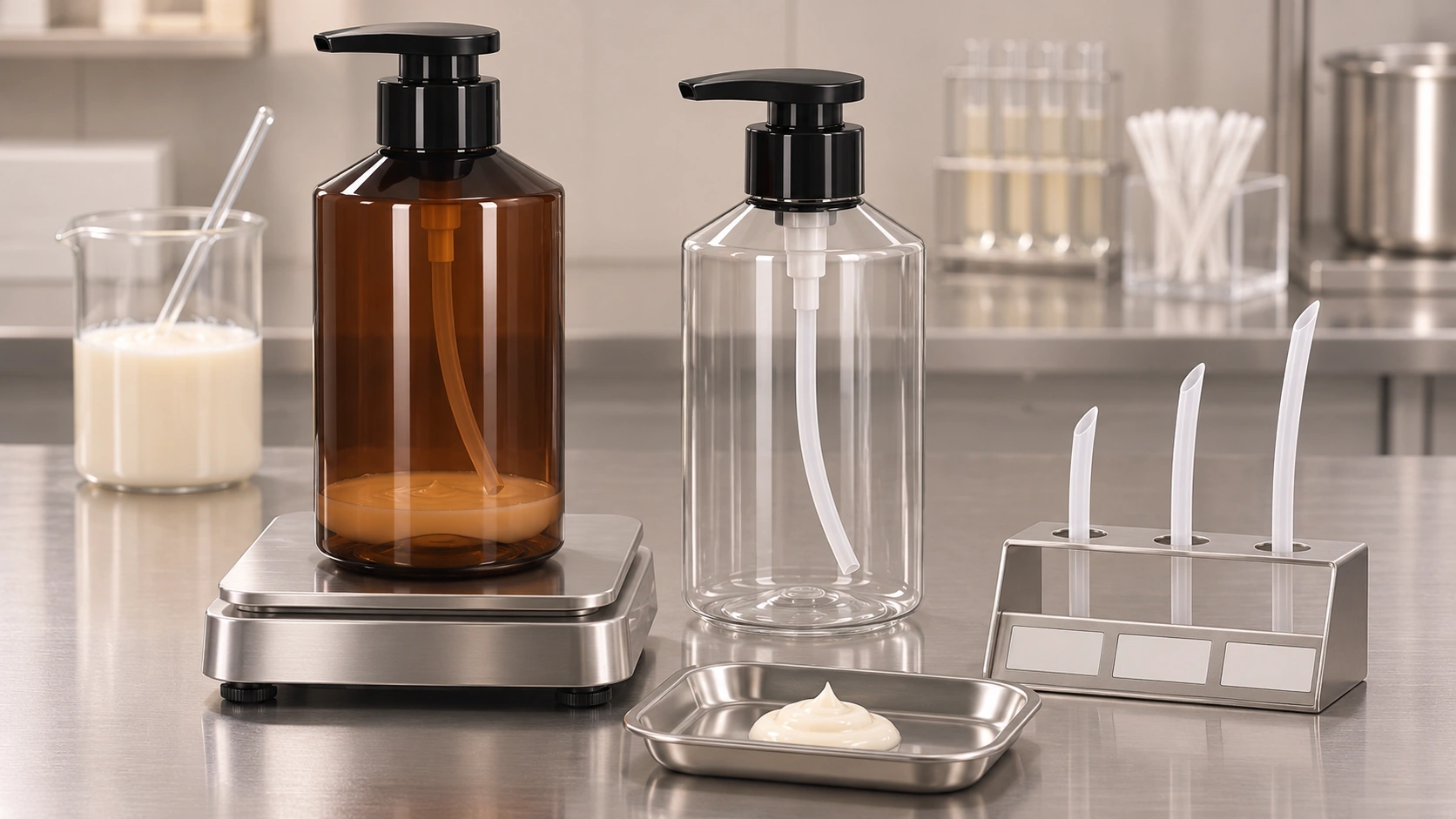
- Inspect the tube for kinking, wall contact, sharp curvature, and tip blockage after assembly.
- Compare upright use with any tilted orientation expected during normal application.
- Condition samples at relevant temperatures and repeat prime and recovery checks.
- Weigh the pack before use and after the agreed exhaustion protocol to compare residual product.
If a failure appears, do not change length in isolation. Review the tube inside diameter and stiffness, pump inlet, gasket, closure seating, bottle geometry, formula flow, and cut quality. A different tube length cannot correct an incompatible pump or formula path.
Control the Dimension for Production
Once the filled test identifies an acceptable range, place the final dimension, datum, cut orientation, tube material, inside and outside diameter, and tolerance on the approved specification. Define how the supplier will measure cut parts and how incoming inspection will sample them. Retain an assembled reference because a loose tube length may be misunderstood when the pump captures part of the tube internally.
The existing pump bottle mechanics guide explains the broader role of the actuator, closure, piston, spring, gasket, and dip tube. Use it as background, while keeping this specification focused on the measurement and validation task for one pump-and-bottle combination.
Sonuç
Accurate dip tube length begins with a shared gasket or sealing datum and the bottle’s real internal depth. Subtract a justified trial clearance, cut the installed tube cleanly, and approve the result with the actual formula across priming, dispensing, near-empty pickup, and residual-product checks. The final drawing should describe the complete assembled measurement so the same result can be reproduced in production.
To match a Jaunce Industrial pump or sprayer to a bottle, request a pump and bottle fit check with the bottle drawing or samples, neck finish, closure model, formula type, fill volume, intended use orientation, quantity, and target validation plan.
Sıkça Sorulan Sorular
What Does FBOG Mean
FBOG means From Bottom of Gasket and is used to describe a dip tube measurement reference. Confirm the exact gasket surface and tube-tip point on the supplier drawing because conventions can differ between components.
Should a Dip Tube Touch the Bottle Bottom
It should reach the intended pickup area without being blocked, sharply bent, or pushed into an unstable curve. The correct clearance depends on bottle geometry, tube stiffness, pump inlet, and formula, so approve it through filled testing.
Should the Tube Tip Be Cut at an Angle
An angled cut can help keep a flat tube end from sealing directly against the base, but angle alone does not guarantee pickup. Specify cut quality and orientation, then check the assembled tube and dispensing result.
Can Water Be Used for the Final Test
Water may support an early mechanical check for a thin-liquid system, but it does not represent lotions, shampoos, or other viscous formulas. Final approval should use the commercial formula or a controlled equivalent agreed by the project team.