

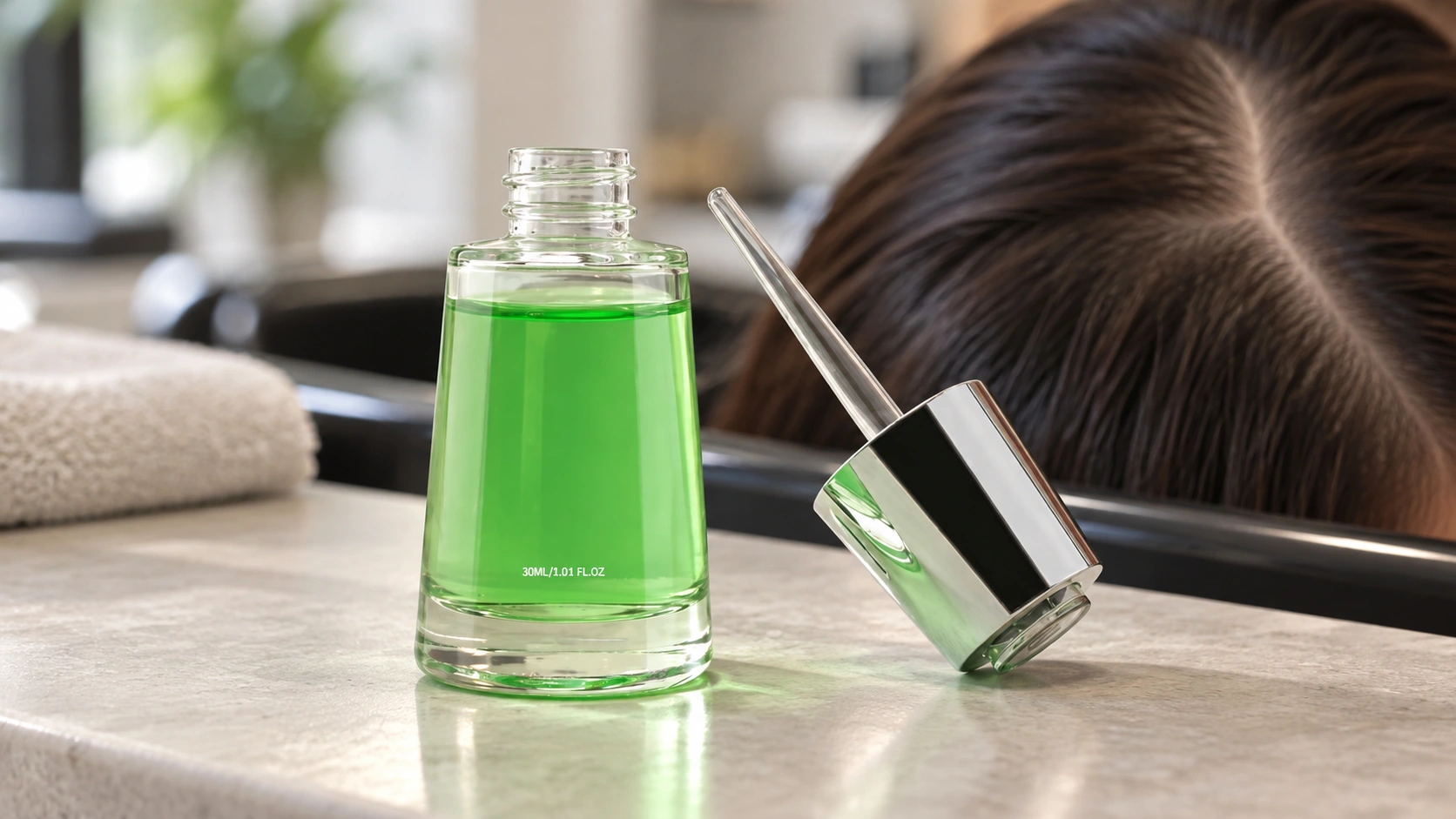
Scalp serum packaging should be selected around the path from bottle to parted scalp. Formula viscosity matters, but so do reach, dose control, application angle, and the risk of leaving product on the hair instead of the skin. A precision tip or dropper may suit line-by-line placement, a spray may suit broader coverage, and a pump may work when the user applies the serum with fingertips. The right package delivers the intended dose consistently with the filled formula.
This use case is narrower than facial-serum packaging. Buyers need to evaluate how consumers separate the hair, whether the applicator can approach the scalp without scratching it, and whether one actuation or squeeze produces a manageable amount. A package that works on a laboratory bench can still feel awkward in a bathroom mirror or salon chair.
Start With the Scalp Application Path
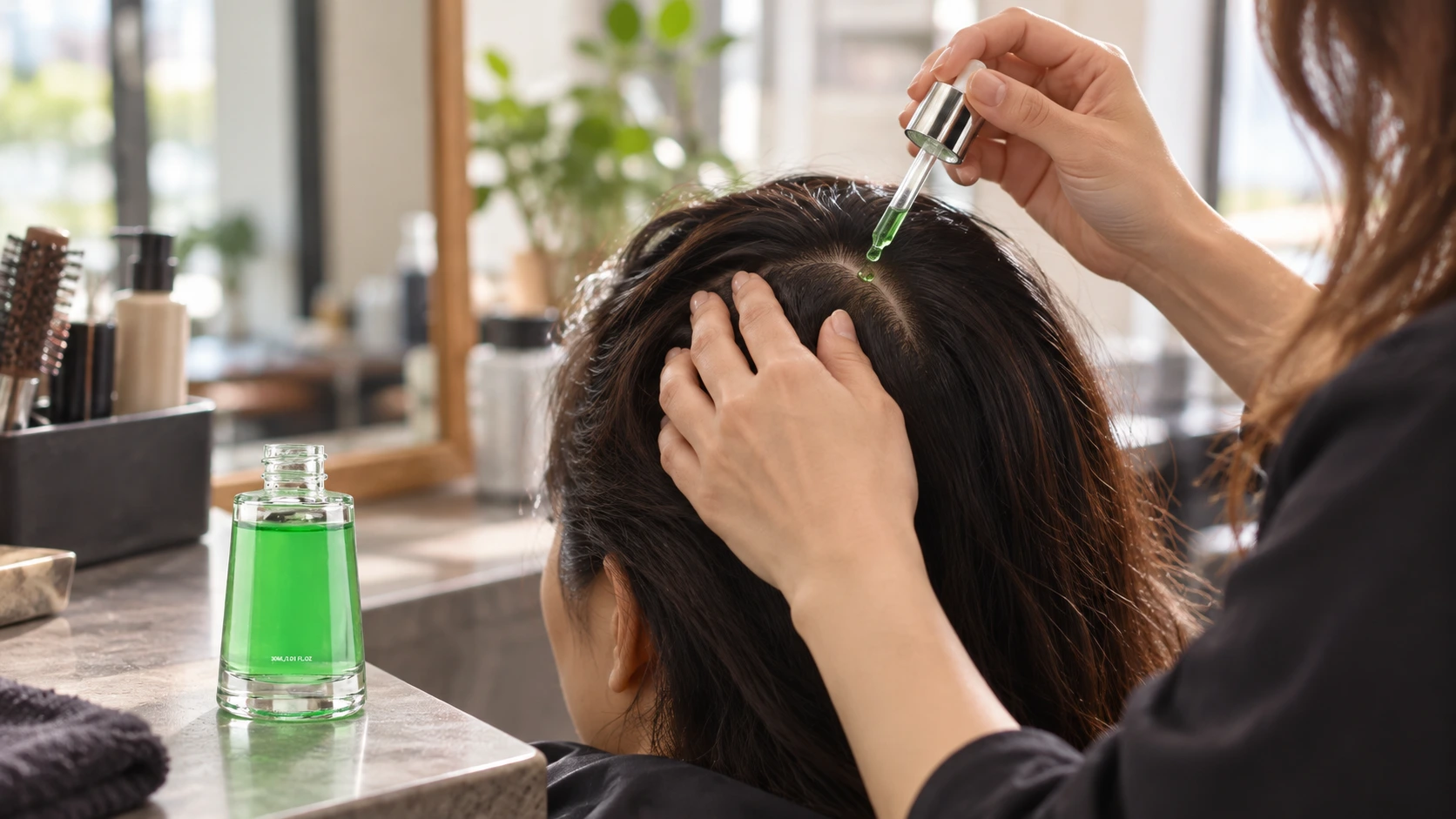
Define the intended routine before choosing a bottle. Will the user create several part lines and place drops along each line, draw a narrow path with a nozzle, mist a large area, or dispense into the palm? This determines whether the package needs point accuracy, broad distribution, or a repeatable hand dose. It also changes the direction in which the bottle is held and whether the closure may touch hair or skin.
Write the routine as a short sequence during the concept stage. For example: part the hair, apply to four sections, massage for thirty seconds, and recap. Then estimate the desired total dose and divide it across the sections. This gives the supplier and filler a practical target for the closure trial. Avoid treating a full pipette or one pump stroke as a dose until filled samples have been measured.
- For home use, check whether the user can operate the package with one hand and see the point of application.
- For salon use, check speed, grip with damp hands, closure hygiene, and repeated opening during a service.
- For travel or sampling, check whether the reduced fill still primes and dispenses as intended.
Match the Dispensing Format to Scalp Use
Direct-to-scalp formats should reach through the hair and place product where the treatment is intended. The opening should be narrow enough for control but not so restrictive that a viscous formula requires excessive force. Broad-dispersion formats should be chosen only when the product is meant to cover a larger area and some contact with the hair is acceptable.
| Định dạng | Mùi hương & Dầu: Nước hoa, Tinh dầu, Roll-ons | Main checks |
| Thuốc nhỏ giọt | Low to medium viscosity and measured transfer along part lines | Pipette fill, drip control, dose repeatability, cap cleanliness |
| Precision tip or nozzle | Targeted lines or small scalp zones | Flow resistance, tip comfort, squeeze force, closure seal |
| Fine mist spray | Wide, light coverage with a low-viscosity formula | Spray pattern, droplet size, hair wetting, clogging, actuator lock |
| Pump or airless | Dispensing to fingertips before massage | Priming, dose per stroke, residue, orientation, near-empty delivery |
A dropper can support controlled transfer, but the user still has to position it above the scalp and manage each drop. A long precision nozzle can improve reach, yet the formula must move through the smaller flow path without stringing or surging. A spray can be fast, but it may place more product on the hair and create uneven local dosing. A pump offers a repeatable hand dose, although it removes the direct-to-scalp advantage.
When the project also needs a general comparison of pumps, droppers, and airless systems, use the general serum packaging guide as a complementary reference. The scalp project should still be approved against its own parting and application routine.
Use Viscosity as a Test Input
Viscosity labels such as watery, light serum, or oil are not enough for closure approval. Flow changes with temperature, thickener system, suspended material, and the shear created inside a pump or nozzle. Ask the formulator for a working viscosity range and note whether the product separates, contains particles, or changes after storage. If the final formula is unavailable, document why the substitute is representative.
Run dispensing checks at more than one relevant condition. A formula that sprays well at room temperature may narrow its pattern after cool storage. A dropper that fills easily with a thin prototype may underfill when the commercial batch is thicker. Record the exact filled assembly, temperature, number of units, and observation point so the result can be repeated.
Set Capacity From Dose and Routine
Capacity should follow the dose per use, frequency, expected use period, and retail role. Start with the intended daily or weekly dose, multiply by the planned number of uses, and add only the justified allowance needed for filling and dispensing behavior. This calculation is more useful than copying a common facial-serum size.
A smaller pack can suit a concentrated treatment, trial program, or travel SKU, while a larger pack can suit frequent whole-scalp use. The larger option also increases filled weight, shelf space, transport exposure, and the time the closure remains in service. Compare the usable doses delivered, not only the nominal bottle volume. Near-empty performance is especially important when a long nozzle, dip tube, or airless mechanism is used.
Test the Complete Filled Assembly
Compatibility and dispensing checks
Test every wetted component with the intended formula, including the bottle, gasket, dip tube, pipette, bulb, actuator, insert, and cap liner where present. Observe appearance, odor, viscosity, discoloration, swelling, stress cracking, pump movement, nozzle blockage, and changes in seal feel. Packaging compatibility does not establish product stability, preservation, safety, or shelf life; those decisions require the finished product and the brand’s validation plan.
Leak and transport checks
Check upright, side, and inverted storage where relevant, then add temperature cycling and transport simulation based on the distribution route. Inspect the closure immediately and again after a defined dwell period. Record weight loss, visible wetness, cap contamination, and carton staining. Repeat the assessment after opening and reclosing because consumer handling can change the seal condition.
Move From Sample to RFQ With Jaunce Industrial
Công ty Jaunce Industrial serum pump bottle range provides a starting point for glass pump and dropper formats. A press-pump and dropper bottle example can be used to discuss closure style, custom color, and surface finish, but the final capacity and component configuration should be confirmed for the selected model.
Use the packaging project support process to submit product type, capacity, quantity, decoration needs, target market, material, component structure, and sample requirements. After the functional package is defined, the Dịch vụ đóng gói OEM/ODM is the appropriate route for custom development discussions.
A useful RFQ should include the formula category and viscosity range, target dose, application sequence, preferred dispenser, acceptable alternatives, fill volume, quantity by variant, decoration, filling location, destination market, and acceptance checks. Ask for the bottle and dispensing components as one quoted assembly. Jaunce Industrial can then respond against a specific configuration rather than a generic serum-bottle request.
Kết luận
Choose scalp serum packaging by following the formula from the bottle to each scalp section. Confirm that the dispenser reaches the intended area, controls the dose, remains comfortable to use, and passes filled compatibility and leakage checks. Capacity should reflect the treatment routine, and decoration should begin only after the working assembly is approved.
For a project review, request a model-specific fit review with the formula type, viscosity range, target dose, application method, preferred capacity, quantity, decoration, and destination market.
Câu hỏi thường gặp
Is a dropper always best for scalp serum?
No. A dropper supports controlled transfer, but a precision nozzle may offer better reach through dense hair, while a spray may suit broad light coverage. Select the format from the actual application routine and filled-formula tests.
How should a scalp applicator bottle be tested?
Test several filled units during realistic parting and application. Measure dose consistency, flow, comfort, residue, reclosing, leakage, and performance after storage and repeated use.
What bottle size suits scalp serum?
Calculate it from dose per use, use frequency, intended treatment period, and near-empty recovery. A trial, concentrated treatment, and frequent whole-scalp product may require different capacities.
Can a fine mist sprayer handle every scalp formula?
No. Sprayability depends on viscosity, particles, temperature, actuator design, and the desired pattern. Verify clogging, droplet distribution, and how much product lands on hair rather than scalp.
When should decoration be approved?
Approve decoration after the bottle, dispenser, formula compatibility, and leak checks pass. Then evaluate color, adhesion, print area, grip, and appearance on the exact assembly.